La Copa del Mundo 2026 transformará la economía de las comunidades anfitrionas. Explora cómo el evento abordará desafíos y controversias clave en la región.
Introduction to the social impact of the 2026 World Cup
The 2026 World Cup represents a unique case in the history of global sports: for the first time, it will be held in three countries —Canada, Mexico, and the United States— with 16 host cities, 48 teams, and 104 matches taking place from June 11 to July 19, 2026. This expansion turns the tournament into a continental social phenomenon, not only due to the volume of visitors and audiences but also because of the diversity of urban, political, and cultural contexts involved. The host cities include Toronto and Vancouver; Guadalajara, Mexico City, and Monterrey; and eleven U.S. metropolitan areas, including Los Angeles, Dallas, Miami, New York/New Jersey, Seattle, and Atlanta.
Analyzing its social impact requires going beyond soccer. The Cup acts as a catalyst for public and private investment, a tourist showcase, a laboratory for urban mobility, and a stage for tensions over human rights, security, housing, migration, and the use of public space. In 2026, the World Cup will not only measure North America’s organizational capacity but also the way large cities distribute benefits and costs among residents, businesses, visitors, and vulnerable communities.
Economic effects on host communities
The economic argument in favor of hosting the World Cup is based on three main promises: increased tourism, temporary job creation, and international promotion of the cities. In New York/New Jersey, the host committee projected a regional economic impact of $3.3 billion, over 26,000 supported jobs, more than 1.2 million visitors, and $431.9 million in state and local tax revenues. These figures demonstrate the tournament’s appeal to sectors such as hospitality, transportation, dining, retail, and entertainment.
Toronto offers another example of local economic logic. A municipal report estimated that the spending related to the event could generate around CAD 485 million in direct business activity through an impact model, and up to CAD 875 million when including direct, indirect, and induced effects. It also projected thousands of full-time equivalent jobs and significant demand for overnight stays and visits.
However, the social impact of these benefits depends on their distribution. Jobs linked to mega-events often concentrate in temporary services, security, logistics, and hospitality, with a limited duration. For the World Cup to leave a positive net impact, cities must facilitate the participation of small local businesses, community suppliers, and workers with dignified labor conditions. Otherwise, the benefit may concentrate in hotel chains, global sponsors, and tourist areas, while residents bear congestion, rising prices, and pressure on public services.
Impact on infrastructure and urban planning
One of the distinctive features of 2026 is that many host cities already had large-capacity stadiums, reducing the risk of building “white elephants” in sports. Still, the urban impact is considerable. Cities have had to adapt transportation systems, security, signage, accessibility, fan zones, and metropolitan coordination. In the United States, several stadiums are located far from urban centers, making mobility one of the biggest social challenges of the event. The case of Arlington, home to the Dallas stadium, is relevant because it lacks a mass public transportation system and relies on special bus solutions and regional connections.
The World Cup infrastructure could leave useful improvements if it strengthens public transport, universal accessibility, crowd management, and coordination between municipalities. But it could also lead to ephemeral, costly interventions oriented more toward visitors than residents. In Vancouver, provincial and local authorities updated cost, revenue, and benefit estimates, forecasting around 350,000 spectators for seven matches, nearly CAD 1 billion in GDP for the economy of British Columbia, and over CAD 200 million in related provincial tax revenues. Meanwhile, the combined local and provincial security costs were estimated at around CAD 242 million.
From an urban planning perspective, the challenge is to ensure planning doesn’t stop at the month of the tournament. The routes, stations, public spaces, and digital services created or enhanced for the World Cup must be integrated into city strategies: sustainable mobility, pedestrian access, emission reduction, community use of facilities, and reclaiming public spaces for cultural and sporting activities.
Social cohesion and cultural diversity
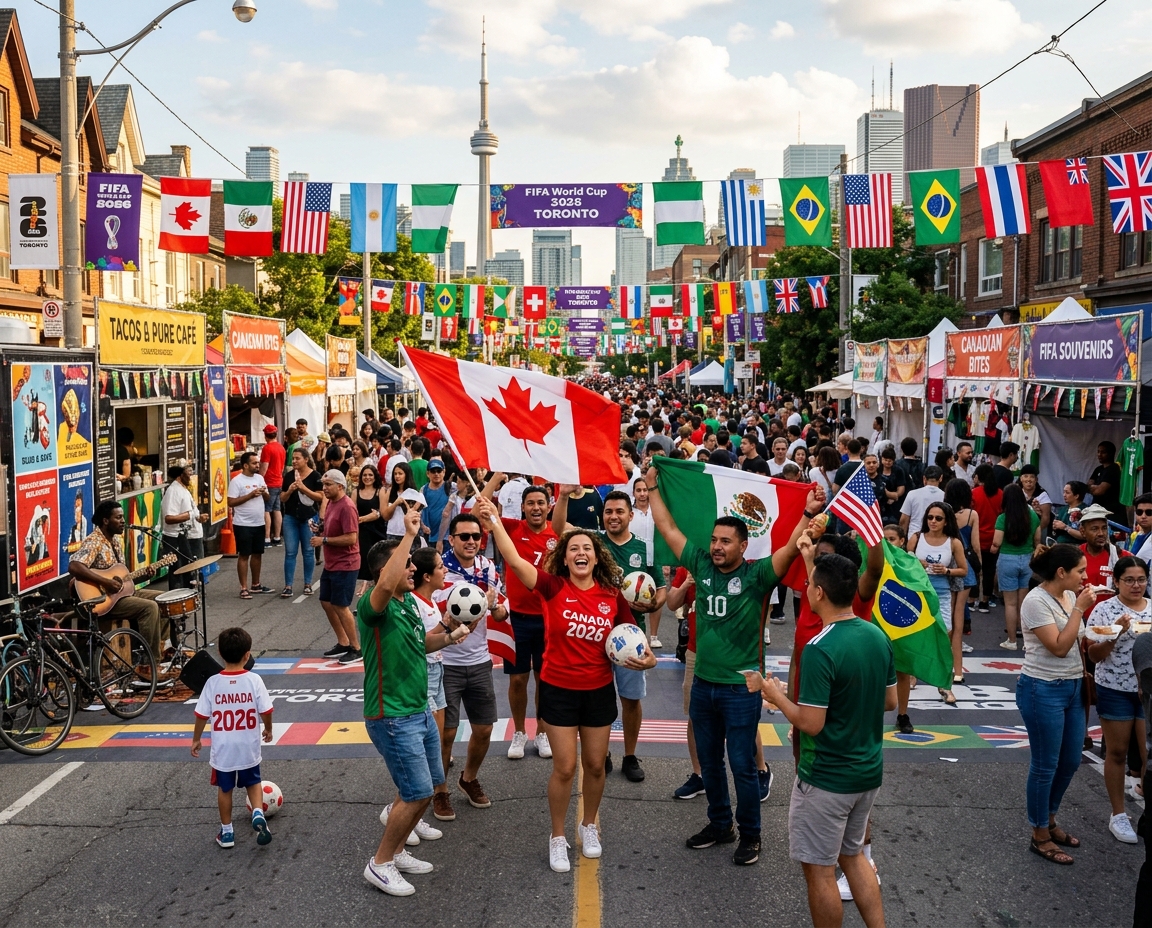
The World Cup has an exceptional capacity to produce symbolic encounters. In cities with large migrant communities, the tournament activates multiple identities: it celebrates the host country, the country of origin, and the teams that represent cultural or familial affinities. In the United States, Canada, and Mexico, this phenomenon is particularly visible due to the presence of Latin American, European, African, Asian, and Caribbean communities. Fan zones, cultural events, volunteer opportunities, and public broadcasts can strengthen intercultural coexistence and give visibility to historically marginalized neighborhoods.
The cultural dimension is also expressed in the relationship with Indigenous peoples and local communities. Vancouver has highlighted collaboration with the Musqueam, Squamish, and Tsleil-Waututh Nations, presenting the tournament as an opportunity to share culture, history, and traditional territory with international audiences. This type of participation can enrich the social legacy if it is not reduced to a ceremonial gesture and if it translates into lasting benefits, institutional recognition, and real participation in decision-making.
Soccer, due to its universal language, can generate cohesion, civic pride, and youth participation. Community court programs, school tournaments, and neighborhood activities can transform the excitement of the World Cup into sports habits and social ties. However, cohesion does not emerge automatically: it requires free or affordable access to celebrations, protection against discrimination, non-intimidating security, and policies that include residents who cannot afford tickets.
Challenges and controversies associated with the event
Mega-events often reveal preexisting inequalities. In 2026, the main controversies relate to human rights, migration, security, housing, freedom of expression, and public costs. Amnesty International warned that fans, workers, journalists, and local communities could face risks related to migration policies, restrictions on protest, and potential displacements of homeless people in the three host countries.
Human Rights Watch also noted that this World Cup was the first to incorporate human rights requirements into the bidding process, a human rights strategy, and a binding framework for host city committees. However, the organization criticized that, two months before the tournament, only a few cities had published human rights action plans, even though the framework required consultations with governments, community organizations, and local actors.
Security is another sensitive point. Large gatherings require prevention, medical services, crowd control, and protection against real threats. But excessively militarized security can undermine community trust, especially among migrants, racialized individuals, informal vendors, and protesters. The central question is whether cities can guarantee public order without turning the World Cup environment into one of selective surveillance.
There are also economic tensions. Impact projections often present optimistic scenarios, while the costs of transportation, security, cleaning, event management, and urban adaptation partially fall on local governments. If tournament revenues —TV rights, sponsorships, and global ticket sales— mainly benefit FIFA and large commercial actors, communities may perceive a gap between the spectacle and their daily needs.
Conclusion and reflections on the legacy of the 2026 World Cup
The social legacy of the 2026 World Cup will not be determined solely by the quality of the matches or the number of visitors. It will depend on concrete public decisions: fair hiring, support for local businesses, accessible transportation, protection of rights, cultural inclusion, and subsequent use of investments. The tournament can strengthen urban pride, expand sports practice, and project a diverse image of North America; but it can also deepen inequalities if it displaces vulnerable populations, raises service costs, or prioritizes the tourist experience over the daily life of residents.
Ultimately, the 2026 World Cup should be evaluated as a temporary social contract between organizers, governments, and citizens. Its success will not be measured only in goals, audiences, or revenues but in whether host communities are left better connected, more visible, more inclusive, and with a greater capacity to leverage sports as a tool for integration. The true legacy will be social, or it will not be a legacy at all.
The content is provided by Sierra Knightley, Front Signals