
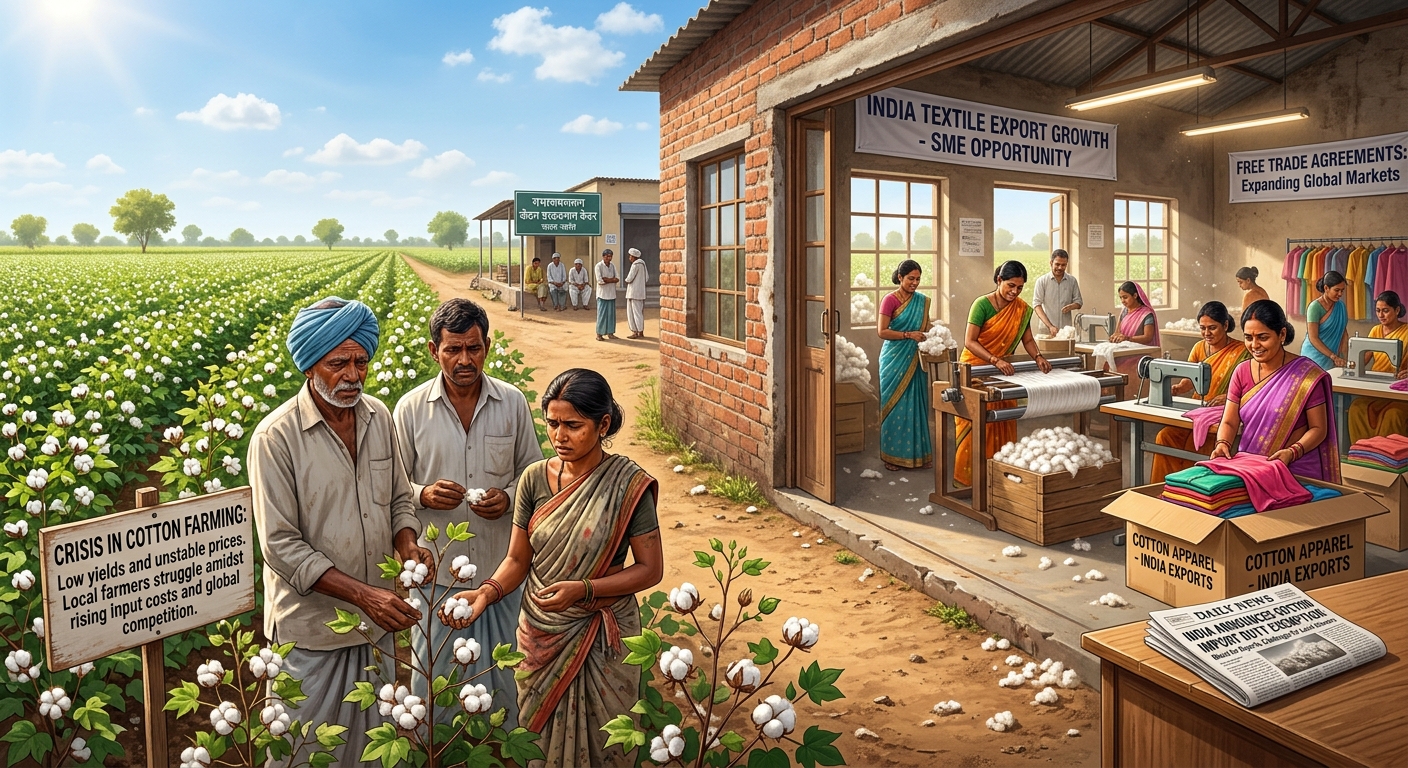
Summary of Temporary Cotton Import Duty Relief
The Indian government has implemented a five-month relief from customs duties and Agriculture Infrastructure and Development Cess (AIDC) on raw cotton imports, effective June 1 to October 31, 2025. This policy addresses domestic cotton shortages due to rising demand and external factors, aiming to lower costs for India’s textile and apparel industries. By facilitating easier access to cotton, particularly for micro, small, and medium enterprises (MSMEs), the measure aims to stabilize prices and enhance export competitiveness in light of international trade agreements.
Policy Background
The duty exemption on raw cotton began on August 19, 2025, as a response to escalating domestic fiber costs and competitiveness challenges. Following this, imports surged, notably from the U.S., helping to lower domestic prices significantly. This reflects a strategic government effort to bolster businesses while ensuring that increased imports do not hinder domestic production capabilities.
Five-Month Duty Relief Justification
This temporary policy targets rising cotton prices attributable to diminished production and significant external influences. The temporary waiver is intended to improve raw material availability and decrease costs for textile manufacturers at a time when domestic demand far exceeds supply. This balanced approach seeks not only to support MSMEs but also to maintain fair competition and farmer welfare through mechanisms like Minimum Support Price (MSP).
Exemption Details and Limitations
The duty exemption applies specifically to cotton under tariff heading 5201, aimed at easing access to supplies when domestic production is low. While facilitating cheaper imports, the government retains protective measures for local farmers to mitigate adverse effects on prices and income. This careful targeting intends to ensure that domestic producers can coexist with new import dynamics without undue financial strain.
Trade and Market Outcomes
The exemption has led to notable shifts in the trade landscape, significantly increasing the volume of U.S. cotton imports. This influx has positioned Indian textile manufacturers advantageously amid ongoing global competition, offering potential for revived export growth. The Indian government’s supplemental procurement efforts during this transition address concerns related to farmer income stability amidst fluctuating domestic prices.
Broader Economic Effects
Economically, the duty relief is expected to stabilize prices and maintain competitiveness in the textile sector, crucial for sustaining employment and market positioning. Despite these benefits, domestic cotton farmers express concerns over income stability due to increased competition from imported cotton. This raises critical questions about the sustainability of domestic agriculture in face of changing import dynamics and global market fluctuations.
Trade Measure Comparisons
India’s cotton import duty relief stands distinct from other trade frameworks, favoring immediate industry needs while highlighting disparities in international tariff structures. The recent adjustments in reciprocal tariffs under various agreements highlight the complexity of global trade interactions, suggesting that immediate relief measures can coexist with longer-term strategies aimed at sustaining competitiveness across diverse markets.
Industry and Government Reactions
The cotton import duty exemption has received a favorable response from industry stakeholders who see it as vital for maintaining production levels amidst market pressures. However, ongoing disputes reflect the tension between supporting textile exporters and addressing the needs of local cotton farmers. This nuanced dialogue continues to shape policies around trade liberalization and support for domestic agricultural sectors.
Criticism and Market Challenges
The temporary relief has drawn criticisms primarily from domestic farmers concerned about falling prices and potential distress sales. Critics argue that this focus on export competitiveness undermines the financial security of local producers. Policymakers face the difficult task of balancing the needs of both sectors while navigating complex global market influences and maintaining sustainable agricultural practices.
The content is provided by Harper Eastwood, Front Signals