
Summary of Recent Market Decline
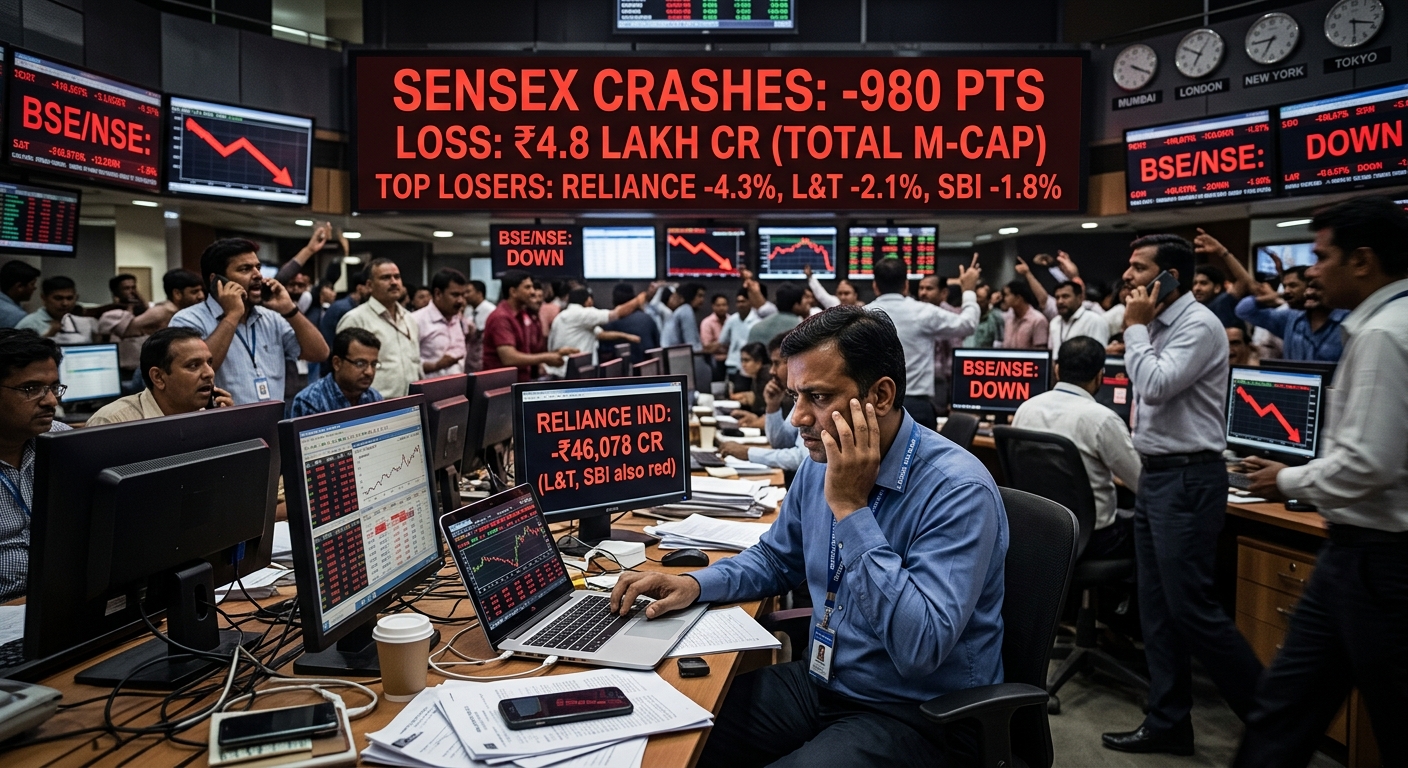
Recent downturns in the Indian equity markets resulted in major firms, particularly Reliance Industries Limited, losing approximately ₹1.54 lakh crore in market capitalization within a week. Reliance led the losses with around ₹46,078 crore, reflecting the company’s significant impact on market trends. The downturn was influenced by foreign institutional investor (FII) outflows, global economic pressures, and sector-specific challenges, indicating a shift in investor sentiment and highlighting the need for companies to adapt strategically.
Significance of Market Capitalization Trends
The substantial decline in market capitalization raises concerns about the current positioning of Indian firms globally. As of early 2026, no Indian company ranks in the top 100 globally, a shift from previous years. This emphasizes the volatility of the market and the impact of technological changes on investor confidence. Investors considering entering or remaining in the market should assess broader economic indicators coupled with financial health rather than solely relying on market capitalization figures.
Specific Sector Performance During Downturn
The recent sell-off affected prominent companies, with Reliance Industries experiencing the largest drop in market valuation. Other firms, including HDFC Bank and Bharti Airtel, also faced significant declines, whereas companies like Larsen & Toubro and State Bank of India observed gains. This mixed performance highlights sectoral volatility and the influence of external factors on investor behavior. As the market adjusts, it is essential for investors to identify resilient sectors that may present opportunities amidst overall market weakness.
Reliance Industries’ Financial Resilience
Despite a significant drop in market value, Reliance Industries maintains a strong liquidity position, with substantial cash reserves and disciplined financial practices. The company’s diversified operations and focus on strategic investments position it to weather market volatility. Key performance indicators suggest a blend of strength in consumer businesses offsetting traditional sector weaknesses. Investors should analyze these financial metrics closely to gauge long-term viability amidst fluctuating market conditions.
Market Correction Context and Historical Insights
Understanding the recent market correction requires looking at historical patterns where downturns, such as the 2008 financial crisis, repeatedly influenced investor sentiment. Market corrections traditionally occur every few years, emphasizing the inherent volatility of financial markets. For investors, recognizing that these shifts can create opportunities for strategic entry or adjustments in portfolio management may guide their decision-making processes in these challenging times.
Investor Sentiment and Market Reactions
Current investor sentiment reflects caution driven by various economic uncertainties, including inflation concerns and fluctuations in currency value. The recent declines in major indices and the consequent investor behavior highlight the relationship between macroeconomic conditions and market performance. Investors are advised to look beyond immediate market capitalizations and consider factors such as operational health, sector trends, and the overall economic environment when making investment decisions.
Outlook for Recovery and Strategic Adaptation
The ongoing recovery efforts post-market downturns focus on leveraging domestic strengths and strategic repositioning. Reliance Industries demonstrates a commitment to diversifying its operations and mitigating cyclical risks. As market volatility continues, maintaining a robust financial foundation will be crucial for companies navigating the evolving landscape. Investors should monitor economic stabilization efforts and consider the longer-term implications for firms as they adapt to new market realities.
The content is provided by Harper Eastwood, Front Signals