
GDP Growth Overview
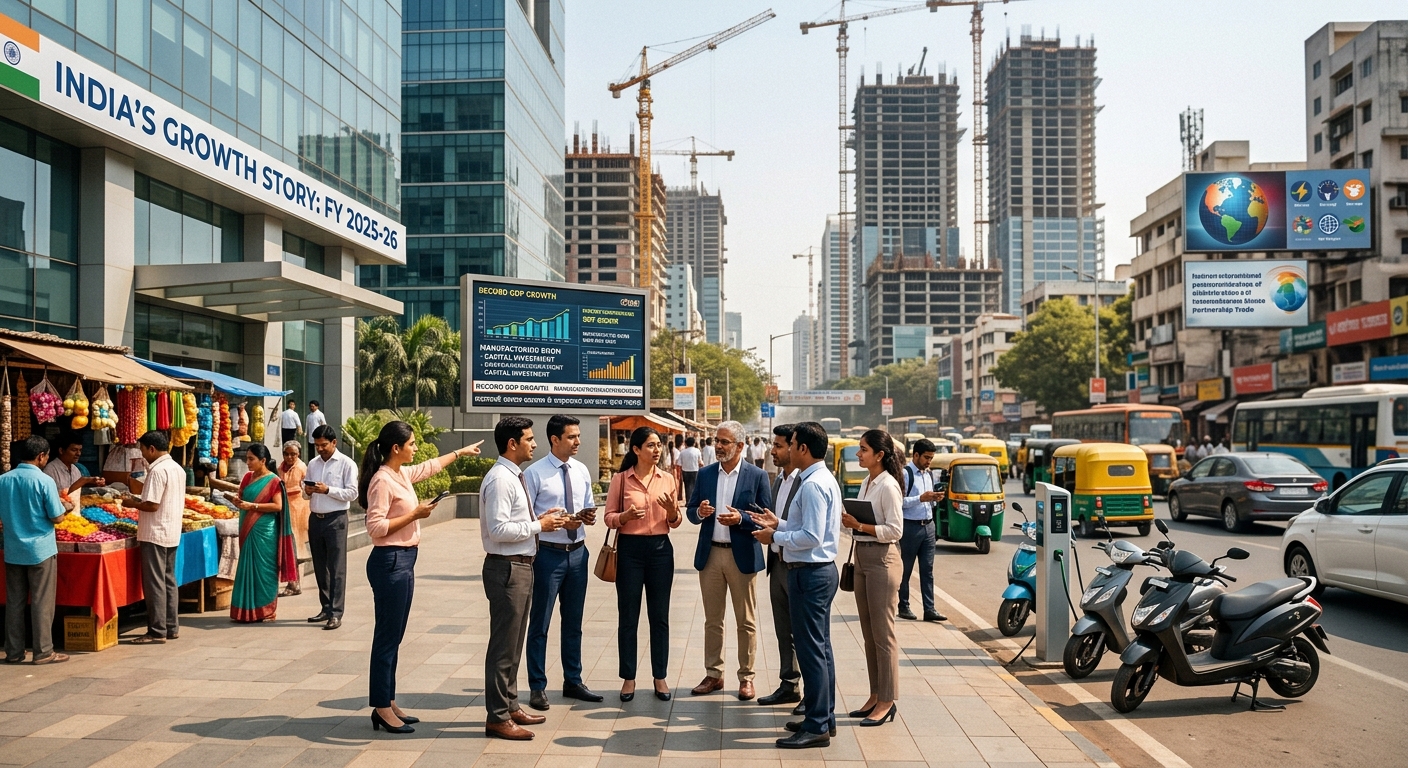
India’s economy exhibited impressive GDP growth of 7.7% for the fiscal year 2025-26 (FY26), with the fourth quarter achieving even higher growth at 7.8%. This growth was largely fueled by strong performances in manufacturing, construction, and services, alongside robust private consumption and significant capital investment. Despite these positive metrics, the Reserve Bank of India (RBI) has revised its GDP growth forecast for FY27 down to 6.6%, reflecting concerns over geopolitical tensions, rising crude oil prices, and potential adverse weather conditions impacting agricultural output and inflation.
Methodological Improvements
The RBI’s updated GDP calculation methodology enhances the precision of national income estimates by integrating improved data sources such as GST records and vehicle registrations while updating the base year to 2022-23. These changes allow for a better reflection of India’s evolving economic landscape, although they also complicate historical comparisons. Key components, such as gross fixed capital formation, capture vital investments in infrastructure and industrial capabilities that are crucial for sustaining growth.
Sectoral Growth Drivers
The manufacturing sector displayed robust growth rates, expanding by 10.7%, supported by government incentives and technological advancements. Similarly, the services sector, which includes trade, transport, and financial services, grew significantly, reflecting a diverse set of contributors to GDP growth. Private consumption expenditure also rose by 7.7%, indicating strong domestic demand, while gross fixed capital formation increased by 8.2%, showcasing sustained investment momentum across various sectors.
Risks and External Factors
Geopolitical tensions, particularly the US-Iran conflict, have created uncertainty around commodity prices and supply chains, prompting the RBI to lower its growth forecast. The rise in fuel prices alongside potential adverse weather impacting agricultural productivity raises concerns about inflation, which is projected to exceed the RBI’s target range. Furthermore, the Current Account Deficit is expected to widen, reflecting vulnerabilities in the external sector amid declining global economic stability.
Policy Responses and Future Outlook
To navigate these challenges, the government emphasizes significant reforms aimed at boosting investments, enhancing job creation, particularly in labor-intensive sectors, and improving infrastructure. Initiatives like the Production-Linked Incentive schemes and increased emphasis on digital innovation support this growth trajectory. The RBI’s consistent monetary policy stance and focus on managing inflation expectations help create a conducive environment for economic stability amid external shocks.
Long-Term Implications
While the impressive growth rates highlight India’s economic resilience, this success also raises questions regarding job creation and income distribution. Ensuring that growth translates into tangible benefits for different socio-economic groups remains a challenge. The need for sustainable structural reforms, focused on financial inclusion and equitable growth, is paramount in harnessing this economic momentum effectively and addressing potential vulnerabilities arising from global market fluctuations.
Debate on Growth Distribution
Critics argue that GDP growth has not been uniformly beneficial across sectors, particularly in labor-intensive industries such as agriculture and manufacturing, leading to concerns about job creation. Policymakers face the challenge of not only maintaining high growth rates but also ensuring that this growth fosters broad-based employment opportunities and increases purchasing power. The geopolitical landscape adds complexity, demonstrating the importance of robust domestic policies that can buffer against external shocks and reinforce the foundations of a more inclusive economy.
The content is provided by Avery Redwood, Front Signals