Summary
Transform Your Commute: How AI is Revolutionizing Traffic Management to Alleviate Congestion explores the transformative impact of artificial intelligence (AI) on urban traffic systems. Traffic management traditionally relies on fixed schedules and manual interventions that often fail to adapt to real-time conditions, leading to congestion, increased travel times, and environmental pollution. The integration of AI enables dynamic, data-driven control of traffic flow through advanced analytics, machine learning, and real-time communication, significantly improving mobility and safety in cities worldwide.
AI-powered solutions such as adaptive traffic signal control, predictive congestion modeling, and intelligent event detection optimize traffic patterns by responding instantly to changing conditions. Notable implementations in cities like Pittsburgh and Los Angeles have demonstrated measurable benefits, including reductions in travel time by up to 26%, decreases in vehicle idling by 40%, and substantial cuts in fuel consumption and emissions. Furthermore, AI enhances road safety by identifying near-miss incidents and abnormal traffic events using sensors and computer vision, contributing to safer and more sustainable urban environments.
Despite these advances, the deployment of AI-driven traffic management systems faces significant challenges. Concerns around data privacy, cybersecurity risks, algorithmic bias, and the environmental footprint of AI infrastructure necessitate robust regulatory frameworks and ethical oversight. Moreover, disparities in technological adoption and funding pose barriers to widespread implementation, especially in resource-constrained cities. Addressing these issues is critical to ensuring equitable and effective use of AI in transportation.
Looking forward, ongoing research into reinforcement learning, large language models, and integrated Vehicle-to-Everything (V2X) communication promises further innovations in traffic optimization and sustainability. As AI systems become more sophisticated and interconnected, they hold the potential to fundamentally reshape urban mobility, supporting greener, safer, and more efficient cities worldwide.
Background
Traffic management involves the organization, guidance, and control of various elements within a traffic system, including stationary and moving vehicles, traffic lights, physical infrastructure, pedestrians, and cyclists. Traditionally, traffic management systems have struggled to adapt dynamically to real-time traffic conditions, often resulting in persistent congestion, increased travel times, higher fuel consumption, and elevated environmental pollution in urban areas.
The emergence of Artificial Intelligence (AI) has significantly transformed traffic management by enabling more responsive and autonomous control mechanisms. AI-powered video analytics, for example, can detect unusual road events such as wrong-way driving or stopped vehicles within seconds, allowing traffic operators to respond immediately and prevent long delays and secondary accidents. This dynamic approach, often referred to as Active Traffic Management (ATM), adjusts traffic control measures based on current or anticipated conditions, improving traffic flow and safety.
Implementing AI-driven traffic systems also facilitates more accurate monitoring of traffic patterns, which benefits urban planners and local businesses alike. By starting with pilot projects in congested corridors, cities can install smart signals and assess their impact, paving the way for broader adoption of intelligent traffic control technologies. Ultimately, these advancements aim to automate traffic scheduling and reduce human intervention, addressing major challenges like congestion and delays in modern vehicle traffic control systems.
Role of Artificial Intelligence in Traffic Management
Artificial Intelligence (AI) plays a pivotal role in modernizing traffic management systems by leveraging advanced data analytics, machine learning, and real-time communication technologies to alleviate congestion and improve urban mobility. AI-powered systems enable faster responses to traffic bottlenecks and optimize traffic flow through critical areas without necessarily requiring new hardware installations, thus supporting proactive traffic management strategies in cities, ports, and airports.
Central to these advancements is the integration of AI within Intelligent Transport Systems (ITS), where vehicles, infrastructure, and control centers continuously share and analyze data through Vehicle-to-Everything (V2X) communication—including vehicle-to-vehicle (V2V), vehicle-to-infrastructure (V2I), and vehicle-to-pedestrian (V2P) interactions. This interconnected ecosystem enhances situational awareness, optimizes traffic signal timing, and reduces congestion by predicting and mitigating potential conflicts.
AI-driven navigation applications further transform commuting by utilizing real-time traffic data sourced from GPS, traffic sensors, and user-generated inputs to dynamically reroute vehicles, minimizing delays and adapting to changing conditions such as weather or accidents. These applications employ variable speed limit (VSL) principles to regulate traffic speed responsively, thereby improving safety and flow efficiency.
Machine learning and computer vision techniques underpin predictive traffic models capable of forecasting congestion with over 90% accuracy by analyzing historical patterns, current vehicle speeds, road conditions, and weather forecasts. These predictions enable traffic control centers to adjust signals, suggest detours, and send timely alerts to drivers, effectively mitigating gridlock and reducing associated emissions.
Real-world implementations of AI-powered adaptive traffic signal control systems demonstrate significant improvements in urban traffic efficiency. For instance, Pittsburgh’s deployment of AI-driven traffic signals resulted in a 26% reduction in travel time and a 40% decrease in vehicle idling. Similarly, Los Angeles’ Adaptive Traffic Signal Control (ATSAC) system managed over 4,500 traffic lights, leading to a 16% fuel consumption decrease and 12% shorter travel times. These systems rely on wireless communication technologies and continuously updated data to optimize signal timing and traffic flow.
AI also enables advanced detection capabilities using sensors such as LIDAR and thermal cameras combined with object tracking algorithms to identify near-miss incidents by analyzing the relative positions and speeds of vehicles and pedestrians. This enhances traffic safety and supports sustainable urban mobility goals by reducing congestion and emissions, contributing to climate objectives.
Despite these benefits, AI traffic systems face challenges related to data quality and fairness. Biased training data can lead to unintended consequences, such as prioritizing vehicle flow over pedestrian safety, underscoring the importance of comprehensive data collection and algorithmic oversight. Moreover, ongoing research explores the integration of external data sources—like pedestrian activity and unexpected road events—and the use of sophisticated microsimulation tools (e.g., SUMO, VISSIM) to further enhance adaptive traffic signal control performance in diverse environments.
AI Applications in Traffic Management
Artificial Intelligence (AI) has emerged as a transformative force in traffic management, offering innovative solutions to address the persistent challenges of congestion, delays, and safety in urban mobility. Traditional traffic control systems rely on fixed signal timings that do not account for real-time fluctuations in traffic density, often exacerbating congestion and inefficiencies. AI applications, by contrast, utilize dynamic and adaptive strategies to optimize traffic flow based on continuous analysis of real-time data from diverse sources such as traffic cameras, GPS devices, road infrastructure sensors, and connected vehicles.
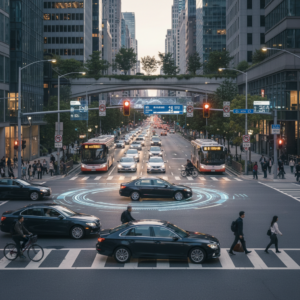
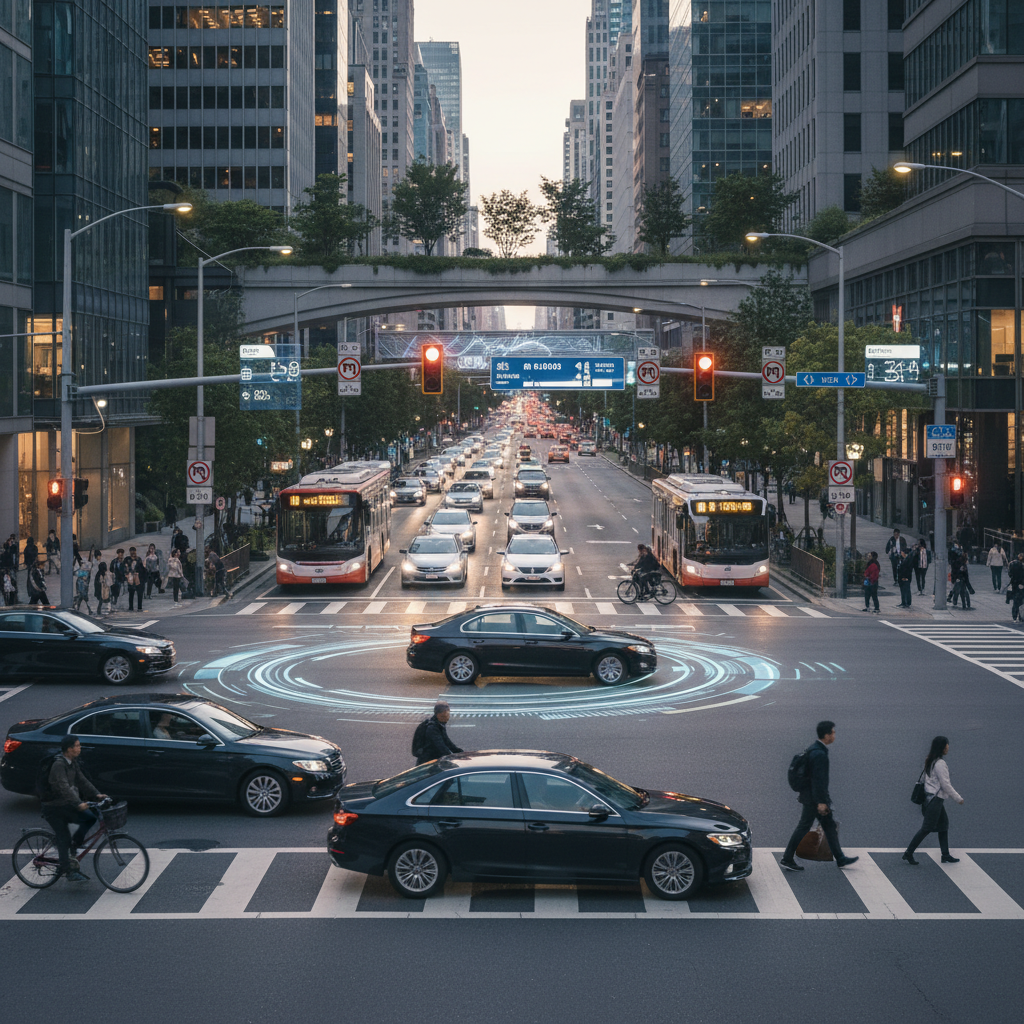
One of the most prominent AI applications is adaptive traffic signal control. Unlike conventional traffic lights with preset cycles, AI-powered traffic signals adjust their timings dynamically according to current traffic conditions, significantly reducing travel time and idling. For example, the city of Pittsburgh implemented AI-driven traffic signals developed by Surtac, achieving a 26% faster travel time and a 40% reduction in idling time. Similarly, Los Angeles’ Adaptive Traffic Signal Control (ATSAC) system manages over 4,500 traffic signals using AI, leading to a 16% decrease in fuel consumption and a 12% reduction in travel time.
Machine learning algorithms play a crucial role in these adaptive systems by learning from historical and real-time traffic patterns to predict congestion and optimize signal timings. Deep learning models, including multilayer neural networks, have been applied to forecast traffic flow over intervals ranging from 15 to 60 minutes, improving the precision of traffic management decisions. Reinforcement learning techniques have also been employed to enable data-driven, real-time optimization of traffic signals, demonstrating superior performance in handling complex and variable traffic scenarios.
Beyond traffic signals, AI enhances event detection and safety monitoring at intersections. Using technologies such as LIDAR, thermal cameras, and AI-based video analytics, systems can detect unusual events—like vehicles traveling the wrong way or stopped trucks—and alert authorities instantaneously, preventing delays and secondary accidents. Moreover, AI algorithms can identify near-miss incidents by analyzing the trajectories and speeds of pedestrians, cyclists, and vehicles, facilitating proactive safety measures.
Another significant application is the integration of Vehicle-to-Everything (V2X) communication, where connected vehicles and infrastructure exchange data to optimize traffic flow and safety. This ecosystem allows real-time adjustments in signal timings based on vehicle speed, position, and braking data, thus reducing congestion and improving overall traffic efficiency. AI systems also prioritize diverse road users beyond cars and trucks, including trams, bicycles, e-scooters, and pedestrians, promoting safer and more equitable mobility.
AI-driven traffic management has measurable environmental and public health benefits. By optimizing signal timings and reducing congestion, AI systems cut down vehicle emissions and air pollutants that negatively impact residents’ health. Some cities have integrated AI route optimization into their transit planning, further lowering emissions and enhancing mobility for public transport users.
Finally, predictive AI models enable traffic authorities and commuters to anticipate congestion with over 90% accuracy by analyzing factors such as historical traffic data, road construction, weather, and current vehicle speeds. These predictions support faster emergency response times, improving safety and reducing the duration of traffic disruptions.
Benefits of AI-Driven Traffic Management
AI-driven traffic management systems offer significant advantages in addressing the persistent challenges of urban congestion, environmental impact, and road safety. By leveraging real-time data from traffic cameras, GPS devices, and infrastructure sensors, AI technologies enable continuous analysis and dynamic adaptation of traffic controls to optimize flow and reduce delays.
One of the primary benefits is the reduction of traffic congestion, which in turn lowers travel time and fuel consumption. Traditional traffic management often struggles to adapt quickly to changing conditions, whereas AI-based systems can autonomously adjust signals and routes based on current vehicle density, minimizing stops and starts. For example, adaptive traffic lights in Singapore have demonstrated a 22% reduction in intersection delays, contributing to smoother traffic and less idling.
Environmental improvements are another major advantage of AI-enhanced traffic management. Efficient traffic flow reduces emissions of CO₂ and other pollutants, improving air quality and public health. Case studies show that AI systems can achieve up to a 25% reduction in CO₂ emissions during peak hours, as seen in Beijing’s deployment of deep reinforcement learning models. Moreover, even partial implementation in high-traffic areas can yield noticeable decreases in emissions—up to 20% reduction in CO₂ output—by preventing vehicles from idling and encouraging cleaner fuel consumption.
Beyond congestion and emissions, AI supports enhanced road safety by enabling faster detection of safety-critical events such as accidents or violations of traffic rules. The integration of AI alerts with emergency dispatch services helps clear incidents more quickly, reducing secondary accidents and traffic disruptions. Enforcement of traffic regulations is strengthened by AI tools like video analytics, which help identify infractions such as speeding or red-light running, ensuring the effectiveness of the entire traffic system.
Furthermore, AI systems promote sustainable mobility by prioritizing public transport and active travel modes such as cycling and walking. Implementations such as green waves for cyclists and dedicated lanes for buses and trams encourage modal shifts away from private car use, supporting broader environmental and health goals.
Policy Frameworks and Regulatory Considerations
The integration of AI technologies into traffic management systems necessitates comprehensive policy frameworks and regulatory oversight to ensure their effective and ethical deployment. Policymakers are encouraged to adopt a dual-method approach that balances congestion reduction strategies with sustainability and equity considerations, aiming to create urban transportation systems that are efficient and fair. While safety remains a critical concern, current studies prioritize optimizing traffic flow and reducing congestion as primary objectives.
A key regulatory focus lies in addressing data privacy and security challenges. AI-powered traffic solutions aggregate vast amounts of real-time data, including potentially sensitive personal information, which requires robust protection against unauthorized access and cyberattacks. The broad attack surface created by multiple interconnected devices and technologies demands stringent security protocols and trained personnel to prevent data theft and manipulation that could compromise system integrity or public safety. Ethical issues, such as algorithmic bias and explainability, also call for transparent governance frameworks to maintain public trust and ensure equitable treatment of all road users.
Local governments adopting AI-driven traffic management solutions demonstrate measurable benefits in traffic optimization and roadway safety, but these advances depend heavily on regulatory support to promote widespread adoption and mitigate risks. In scenarios where AI integration and regulatory engagement are minimal, persistent congestion and slow technological uptake are observed, underscoring the importance of proactive policymaking. Continuous monitoring and adaptive regulations are essential to respond to evolving technological capabilities and urban infrastructure changes, such as roadwork or sensor recalibration, enabling AI systems to maintain optimal performance without compromising safety or fairness.
Moreover, environmental policies must consider the ecological footprint of AI technologies. The substantial energy consumption of AI data centers, alongside the production and disposal of specialized electronic components, presents sustainability challenges that regulatory frameworks need to address to minimize carbon emissions and electronic waste associated with AI deployment in transportation. By establishing clear guidelines that integrate safety, privacy, ethical, and environmental concerns, policymakers can facilitate the responsible scaling of AI solutions in traffic management, ultimately contributing to safer, more sustainable, and efficient urban mobility.
Case Studies and Implementations
Numerous cities worldwide have begun implementing AI-driven traffic management systems, demonstrating significant improvements in congestion reduction, traffic flow optimization, and safety enhancements. These case studies highlight both the practical benefits and the challenges of integrating AI technologies into urban transportation networks.
One prominent example is Helsinki’s Smart City mobility program, which employs AI to optimize traffic signals, predict congestion, support autonomous shuttle routes, and integrate multimodal data into a unified platform. The initiative has improved traffic flows by 15–30%, aiming to reduce traffic emissions by 69% from 2005 levels by 2035 and achieve carbon neutrality. Helsinki also pilots autonomous public buses and develops Mobility as a Service (MaaS) applications like Whim to facilitate seamless urban travel.
In the United States, cities such as Los Angeles and Pittsburgh have adopted AI-based adaptive traffic signal control systems with measurable success. Los Angeles’ Adaptive Traffic Signal Control (ATSAC) system manages over 4,500 traffic signals using real-time AI analytics, resulting in a 12% reduction in travel time and a 16% decrease in fuel consumption. Similarly, Pittsburgh implemented AI-powered traffic signals developed by Surtac that adjust to real-time traffic data, leading to a 26% faster travel time and a 40% reduction in idling time, thereby optimizing traffic flow and reducing emissions.
California’s Department of Transportation utilizes AI to monitor highway conditions and respond rapidly to incidents, enhancing traffic safety and minimizing congestion. Moreover, companies like IBM and Google have developed AI-based traffic prediction tools that enable municipalities to proactively manage traffic by adjusting signal timings and providing alternative route suggestions based on real-time data from cameras, sensors, and social media.
The Neom smart city project in Saudi Arabia aims for a zero-congestion and zero-accident future by integrating autonomous vehicles, AI-driven route prediction, and dynamic road usage patterns. This ambitious project exemplifies how AI can be harnessed to fundamentally transform urban mobility and safety at scale.
AI implementations have also shown potential in logistics hubs, such as ports and airports, where intelligent video analytics software like Isarsoft Perception is combined with existing security cameras to monitor traffic flow and congestion in real time. These insights support proactive traffic management without the need for extensive new hardware investments.
Challenges and Limitations
Despite the promising benefits of AI-powered traffic management systems, their widespread adoption faces several significant challenges and limitations. One of the primary obstacles is the minimal integration of AI technologies in urban mobility, largely due to insufficient technological development and a lack of robust regulatory support. This stagnation results in continued reliance on traditional traffic control methods, outdated infrastructure, and inefficient transportation networks that fail to effectively address rising congestion in urban areas.
Another major challenge involves data privacy and security concerns. AI systems in traffic management depend on vast amounts of data collected from diverse sources, including vehicle GPS systems and multiple sensor networks. This data often contains sensitive personal information, which necessitates stringent protections to prevent unauthorized access or misuse. Moreover
Future Directions
The future of traffic management is intrinsically linked to ongoing advancements in artificial intelligence (AI), which hold the promise of transforming urban mobility by optimizing traffic flow, reducing congestion, and enhancing road safety. Emerging technologies such as smart city frameworks and connected vehicles are central to this evolution, enabling real-time data exchange on speed, position, and braking that supports smoother and safer traffic dynamics. These intelligent systems integrate urban planning hierarchies with AI-driven traffic management to create smarter, greener cities that prioritize sustainability alongside efficiency.
One promising avenue involves the use of advanced machine learning models, including reinforcement learning and large language models, to predict and adapt to shifting traffic patterns dynamically. Frameworks like the LLM-RL Traffic Optimization Framework (LLM-RL-TOF) demonstrate the potential of AI to enhance urban mobility by offering more flexible and accurate traffic management solutions compared to traditional methods. Additionally, optimization algorithms such as genetic algorithm-based models have been developed to improve signal timing and reduce journey times under heavy traffic conditions, although integrating real-time behavioral and environmental factors remains an area for improvement.
Sustainability is a critical consideration in the deployment of AI technologies within traffic management. While AI can contribute significantly to reducing greenhouse gas emissions by optimizing transportation networks and enabling carbon-neutral goals, concerns remain regarding the environmental impact of AI systems themselves, including their energy consumption. Consequently, comprehensive frameworks to assess the net climate impact of AI are needed, alongside policies that govern the environmental oversight of AI infrastructure.
Practical implementations of AI-driven traffic solutions in cities such as Helsinki, Dubai, and Chino highlight key objectives including broadening mobility access, reducing reliance on private vehicles, and fostering vibrant, growth-oriented urban environments. These initiatives utilize dynamic traffic signal control, advanced driver-assistance systems (ADAS), and other AI-enabled tools to alleviate congestion and promote sustainable transit options. Lessons learned from these case studies emphasize the necessity of careful planning, stakeholder engagement, and continuous monitoring to ensure the successful and equitable adoption of AI in urban traffic management.
With the proliferation of 5G networks, autonomous and connected vehicles, and increasingly sophisticated traffic prediction models, AI is poised to reshape urban transportation fundamentally. The integration of these technologies offers an unprecedented opportunity to build cities that are not only more efficient and livable but also environmentally responsible.
The content is provided by Jordan Fields, Front Signals