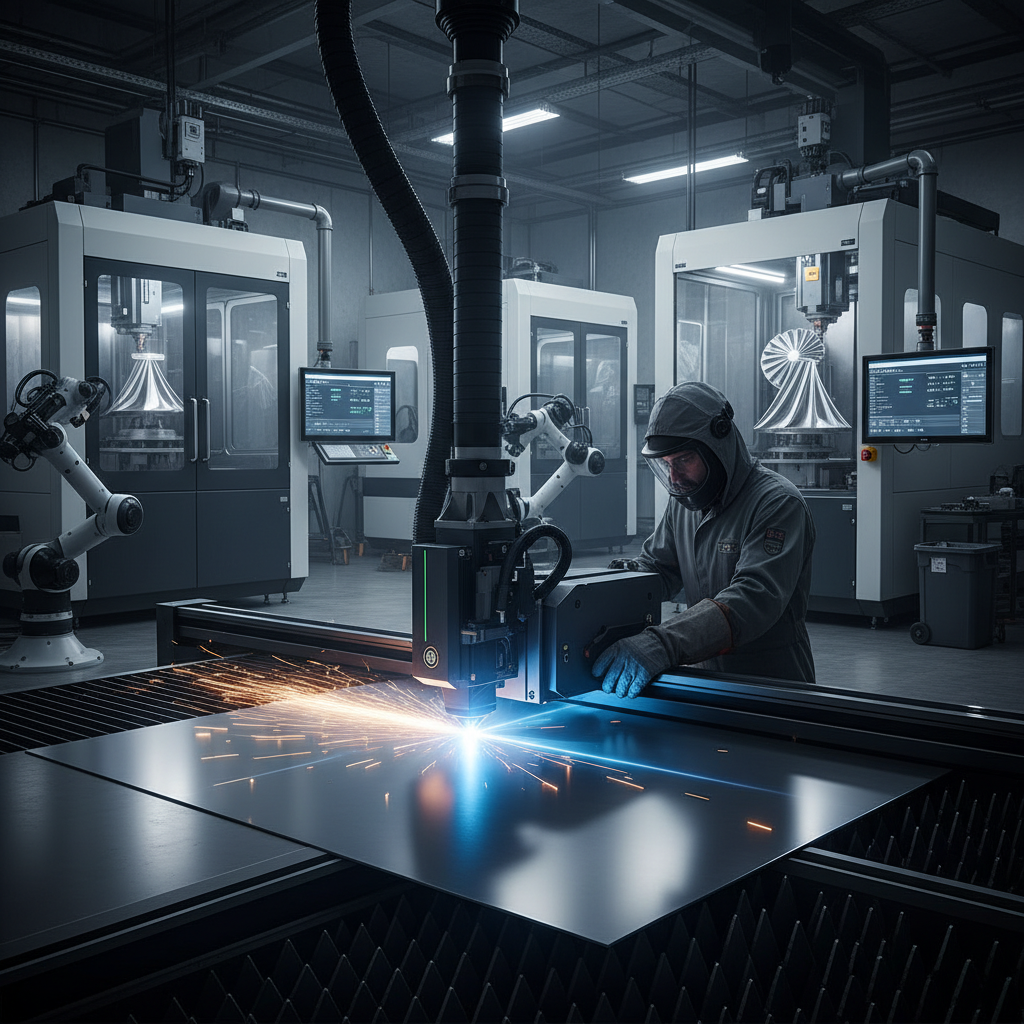
Highlights
- Advanced laser techniques ensure precision in metalworking while minimizing waste and defects.
- Future innovations promise enhanced automation and unprecedented control in laser-based manufacturing processes.
Summary and Development
Precision power and control in laser-based metalworking involve advanced techniques using focused laser beams for accurate cutting, welding, marking, and additive manufacturing with minimal thermal distortion and waste. Various lasers—CO₂, fiber, and solid-state—combined with beam delivery and modulation systems allow fine energy input control, essential for high-quality metal components. Since the first laser in 1960, advances like ultrashort pulse generation and modulation have enhanced precision. Industrial processes such as Powder Bed Fusion (PBF-LB/M) and Directed Energy Deposition (DED-LB/M) use lasers but face challenges in dynamic process control and defect reduction. Innovations in feedback, monitoring, and machine learning aim to improve stability and quality.
Laser technology started with Maiman’s 1960 ruby laser and progressed with ultrashort pulse lasers in the 1980s reaching femtosecond durations, boosting process precision. Metalworking adopted laser-based Powder Bed Fusion and Directed Energy Deposition, though controlling these dynamic processes remains difficult due to defects and limited closed-loop control. Research into laser–material interactions and microstructure analysis aids defect mitigation strategies.
Principles and Techniques
Laser metalworking uses concentrated laser energy to modify metals through cutting, welding, or engraving, relying on material absorption of laser power influenced by wavelength, beam quality, and material properties. Main industrial lasers include CO₂ (10.6 µm), fiber (~1.064 µm), and solid-state Nd:YAG lasers (~1.06 µm). Fiber lasers offer superior beam quality, energy efficiency, and maintenance advantages, enabling precise, minimal heat-affected cuts.
Laser power affects speed and quality; higher power allows deeper penetration but requires balance with parameters like pulse duration to avoid defects. Metals with high thermal conductivity, such as aluminum and copper, need optimized settings for effective energy absorption. Precision depends on machine hardware, material response, and environment, with fiber lasers achieving focal spots down to microns and tolerances as fine as ±0.005 mm.
Precision and control combine mechanical, optical, and electronic methods. Multi-axis CNC machines enable complex cuts with positional accuracy maintained by closed-loop feedback systems. Laser power modulation—digital (TTL) or analog—allows fine power control, with modulation frequencies up to about 30 kHz. Advanced beam delivery includes pulsed lasers for ablation, programmable focusing optics for real-time beam positioning, and integration with robotics for automation. Real-time vision and melt pool monitoring improve process stability and part quality.
Applications
Laser metalworking is used for cutting, welding, marking, additive manufacturing, and forming. Laser cutting offers rapid, precise non-contact machining ideal for thin materials. Laser welding joins complex geometries efficiently, requiring careful power modulation to prevent weld defects. Laser marking modifies surface color or texture without material removal, commonly on metals like stainless steel and titanium. Additive manufacturing via PBF-LB/M and DED-LB/M uses lasers but still struggles with defect control, relying on monitoring and feedback systems. Laser forming induces controlled thermal deformation without mechanical tooling, expanding design flexibility.
Process Quality and Defect Minimization
Quality in laser metalworking depends on controlling factors like laser energy, scanning strategy, and material properties to reduce defects such as porosity, cracking, and surface roughness. In-situ monitoring combined with machine learning enables real-time defect detection and process adjustments. Laser power modulation improves melt mixing and reduces porosity and hot cracking, with modulation frequencies tuned to specific materials enhancing weld stability. Thermal management through controlled cooling and heat treatment minimizes residual stress and deformation.
Advantages, Limitations, and Safety
Laser metalworking provides exceptional precision (tolerances down to ±0.005 mm), flexibility, speed, and reduced waste compared to traditional methods. Robotic integration enhances efficiency and safety by limiting manual handling and exposure to hazards. Assistant gases improve cut quality, enabling broad industrial use. Limitations include the complexity of additive manufacturing processes and the need for precise machine calibration.
Safety concerns center on laser hazards to eyes and skin, requiring protective gear and shielding. Environmentally, laser processing reduces material waste and energy use but can produce harmful fumes needing ventilation. The contactless process minimizes contamination and tool wear, promoting sustainability with proper safety protocols.
Future Trends and Research
Future advances focus on integrating real-time monitoring, closed-loop feedback, and machine learning to optimize laser metalworking, especially in additive manufacturing. ML enhances prediction and control of process outcomes, enabling adaptive adjustments to reduce defects. In-situ sensing and ultrashort pulse lasers promise nanoscale precision and minimal heat impact. Challenges remain in refining ML algorithms, sensor fusion, and process modeling to fully exploit laser technology for complex, high-performance metal components.
The content is provided by Jordan Fields, Scopewires