Highlights
- Discover the latest CDL training advancements and regulatory requirements for a successful career.
- Explore diverse training options to enhance your skills and boost employability in 2024.
Summary
Everything You Need to Know About CDL Training This Year provides a comprehensive overview of Commercial Driver’s License (CDL) training in the United States for 2024, detailing the latest regulatory requirements, training programs, testing procedures, and industry trends. CDL training is essential for individuals seeking to operate commercial motor vehicles such as trucks and buses, with classes ranging from A to C that authorize different vehicle types and cargo capacities. This guide covers the federal Entry-Level Driver Training (ELDT) regulations that standardize minimum training requirements for new drivers, including mandatory endorsements for specialized operations like hazardous materials and tanker hauling.
The article examines the variety of CDL training providers, including community colleges, private schools, and trucking company programs, highlighting differences in curriculum, duration, cost, and delivery formats. Emphasis is placed on recent advancements such as integration of progress tracking technology, blended online and hands-on instruction, and enhanced focus on safety and compliance with Federal Motor Carrier Safety Administration (FMCSA) standards. Additionally, the lead addresses the modernization of CDL testing effective in 2024, featuring advanced skills evaluations, driving simulators, and expanded roles for third-party examiners to improve testing efficiency and integrity.
Regulatory compliance remains a central theme, with training providers required to register with the FMCSA Training Provider Registry and adhere to strict federal and state mandates. The discussion acknowledges ongoing enforcement challenges and varying state-level adaptations, including unique requirements like human trafficking awareness training and temporary pauses in CDL issuance amid rule reviews. The article also contextualizes CDL training within broader industry dynamics, such as a significant driver shortage, evolving employment opportunities, and the growing importance of specialized endorsements for career advancement and higher wages.
Overall, this resource equips prospective CDL applicants, instructors, and industry stakeholders with up-to-date information on how training programs are adapting to regulatory changes, technological innovations, and market demands in 2024. It underscores the critical role of quality CDL training in promoting commercial vehicle safety, workforce readiness, and sustained growth within the trucking and transportation sectors.
Overview of CDL Training
Commercial Driver’s License (CDL) training is a specialized instructional program designed to prepare individuals to obtain a CDL, which is required to operate large or heavy vehicles such as trucks and buses used for commercial purposes in the United States. This training equips students with the necessary knowledge and skills to pass the series of tests mandated for acquiring a CDL.
There are three main classes of CDL licenses—Class A, Class B, and Class C—each authorizing the holder to operate different types of commercial vehicles. Class A CDL holders can operate combination vehicles with a gross vehicle weight rating (GVWR) of 26,001 pounds or more, including trailers exceeding 10,000 pounds. Class B licenses cover vehicles weighing more than 26,000 pounds without a trailer or towing trailers that do not exceed 10,000 pounds, such as delivery trucks and buses. Class C licenses permit drivers to operate vehicles designed to transport 16 or more passengers or hazardous materials, with certain endorsements.
CDL training programs vary widely in format and length and are typically offered through three main types of institutions: community colleges, private truck driving schools, and trucking company-operated schools. Each program type offers different characteristics, so prospective students should carefully evaluate their options to select the best fit for their career goals. The duration of training varies depending on the school and program.
In addition to basic CDL classes, drivers can earn endorsements that qualify them to operate specialized vehicles or haul particular types of cargo. Examples include the Passenger (P) endorsement for vehicles carrying 16 or more passengers, the Tanker (N) endorsement for vehicles hauling liquid freight, and the Hazardous Materials (HazMat) endorsement required to transport hazardous cargo. Some endorsements, such as the Combination (X) endorsement, combine tanker and HazMat qualifications. The Doubles/Triples (T) endorsement permits Class A drivers to haul more than one trailer at a time. Obtaining these endorsements often requires additional training and testing.
Many CDL training programs also cover safety regulations, operating rules, and endorsement-specific requirements, such as for hazardous materials and tanker operations. For example, a 196-hour program may include preparation for Class A CDL, HazMat, Doubles/Triples, and Tanker endorsements, focusing on safe driving techniques and federal compliance. Completing CDL training provides graduates with the credentials necessary to pursue a variety of career paths in the trucking industry and related transportation fields.
Requirements for CDL Training
Commercial Driver’s License (CDL) training is a specialized instructional program designed to prepare individuals to obtain a CDL, which is necessary for a professional truck driving career in the United States. To ensure consistent standards, the Federal Motor Carrier Safety Administration (FMCSA) has implemented the Entry-Level Driver Training (ELDT) regulations, which set the minimum federal training requirements that must be completed before entry-level drivers can take certain CDL knowledge or skills tests.
Before testing for a CDL, applicants are generally required to hold a Commercial Learner’s Permit (CLP) for a minimum of 14 days. In addition to this waiting period, applicants must have a clean driving record and complete an approved commercial driver instructor course, such as those recognized by Service Oklahoma. These courses typically include a minimum of six hours of Driver Education I and II, as well as three semester hours of General Safety Education at an accredited college or university. Depending on specific circumstances, applicants may also need to demonstrate at least five years of experience as a certified law enforcement officer combined with an instructor development course certification.
Starting February 7, 2022, all entry-level drivers applying for a Class A or Class B CDL for the first time must complete training that complies with ELDT standards. This requirement also applies to those seeking to upgrade an existing CDL or obtain certain endorsements. Exceptions to ELDT requirements exist for applicants who obtained their CLP prior to this date and who obtain their CDL before the CLP or renewed CLP expires, as well as for individuals who meet specific exemptions outlined in federal regulations.
Training providers offering CDL instruction must register their programs with the FMCSA and certify that their curricula meet ELDT requirements, which include adherence to the training content specified in 49 CFR Part 380 Appendices A through E, as well as compliance with all applicable federal, state, and local laws. Prospective CDL applicants can find registered training providers through the FMCSA’s Training Provider Registry, which also tracks completion of the required training and certification process.
Additional requirements may apply depending on jurisdictional rules. For example, beginning July 12, 2021, the District of Columbia mandates that all new CDL applicants, as well as those converting out-of-state CDLs, complete mandatory Human Trafficking Awareness training before issuance of a CLP or CDL conversion.
CDL Training Programs
Commercial Driver’s License (CDL) training programs are specialized instructional courses designed to prepare individuals to obtain a CDL, which is mandatory for professional truck driving careers in the United States. These programs teach students the necessary knowledge and skills to pass written and practical tests required for licensure, covering a range of vehicle classes and endorsements tailored to specific commercial driving needs.
Types of CDL Training Programs
CDL training is available through various types of institutions, including community colleges, private truck driving schools, and programs operated by trucking companies. Each type has unique characteristics, durations, and costs, making it essential for prospective students to carefully evaluate which option best suits their needs. Additionally, public and private training providers, educational institutions, state and local governments, and industry organizations may also offer CDL training, either on a “for-hire” or “not-for-hire” basis.
Some programs emphasize rapid preparation; for example, Mercer County Community College offers a four-week CDL Class A training designed to equip students with skills to pass the CDL exam and begin careers quickly. These programs often maintain low student-to-instructor ratios to ensure personalized training, focusing on critical skills such as vehicle inspection, safe operation, and handling of tractor-trailers.
Curriculum and Instruction
CDL training curricula cover theory and practical instruction. Theory instruction includes federal and state regulations, safety procedures, and endorsement-specific topics such as hazardous materials (HazMat), doubles/triples, and tanker operations. While there is no federally mandated minimum number of theory instruction hours, the curriculum must encompass all required topics outlined in federal regulations.
Practical training focuses on basic vehicle control skills, including maneuvering within defined areas and executing driving patterns safely, which are critical for passing the CDL skills test and ensuring road safety. Modernized training programs emphasize these control skills alongside thorough vehicle inspections to reduce accidents and breakdowns. Some schools incorporate progress tracking tools to monitor student proficiency and provide targeted instructional support.
Specialized Training and Endorsements
Beyond obtaining a basic CDL, many programs offer specialized training for endorsements that enable operation of specific vehicle types or transport of hazardous cargo. Examples include HazMat endorsements, tanker endorsements, and doubles/triples endorsements, which require additional testing and instruction. Acquiring these endorsements broadens employment opportunities and often leads to higher wages within the trucking industry.
Delivery Formats and Flexibility
While the practical components of CDL training require in-person attendance, some theoretical coursework is available through online or distance learning, providing flexibility for students balancing other commitments. This blended approach allows learners to complete classroom instruction at their own pace while ensuring they receive hands-on experience necessary for safe driving.
Regulatory Compliance and Quality Assurance
The Federal Motor Carrier Safety Administration (FMCSA) mandates Entry-Level Driver Training (ELDT) standards to ensure consistency and quality across training programs. Training providers listed in the Training Provider Registry (TPR) must comply with these standards, though requirements may vary depending on the licensing state. To aid compliance, some training curricula, such as PowerSuite, offer FMCSA-compliant content with built-in progress tracking to streamline instruction and improve student outcomes.
Concerns about substandard training programs exploiting students have prompted increased regulatory oversight and industry efforts to improve training quality and public safety. Legitimate schools emphasize comprehensive instruction and prepare students not only to pass exams but to operate commercial vehicles safely on the road.
Financial Considerations
CDL training programs vary in cost and duration. Some students may finance their education through loans, employer sponsorships, or federal aid programs. Potential trainees are encouraged to thoroughly research tuition, fees, and financial obligations before enrolling. The trucking industry offers competitive wages, with the median annual salary for heavy and tractor-trailer truck drivers reported at $57,440 as of May 2024, making CDL training a valuable investment for many.
CDL Testing Procedures and Standards (2024 Updates)
In 2024, the Commercial Driver’s License (CDL) testing procedures and standards are undergoing significant modernization to better assess driver skills and improve overall testing efficiency. Effective August 12, 2024, these updates introduce advanced testing modules, new technology, and more flexible testing options aimed at enhancing both safety and accessibility for CDL applicants.
Modernization of Skills Testing
The updated CDL skills test incorporates advanced modules designed to evaluate a driver’s ability to handle complex and real-life driving scenarios. These modules focus on critical vehicle control skills and safety inspection procedures, ensuring applicants are well-prepared to operate commercial motor vehicles (CMVs) safely. The inclusion of real-world situations in testing aims to reduce breakdowns and accidents by emphasizing thorough knowledge of vehicle inspection points and operational competence.
Use of Technology and Alternative Methods
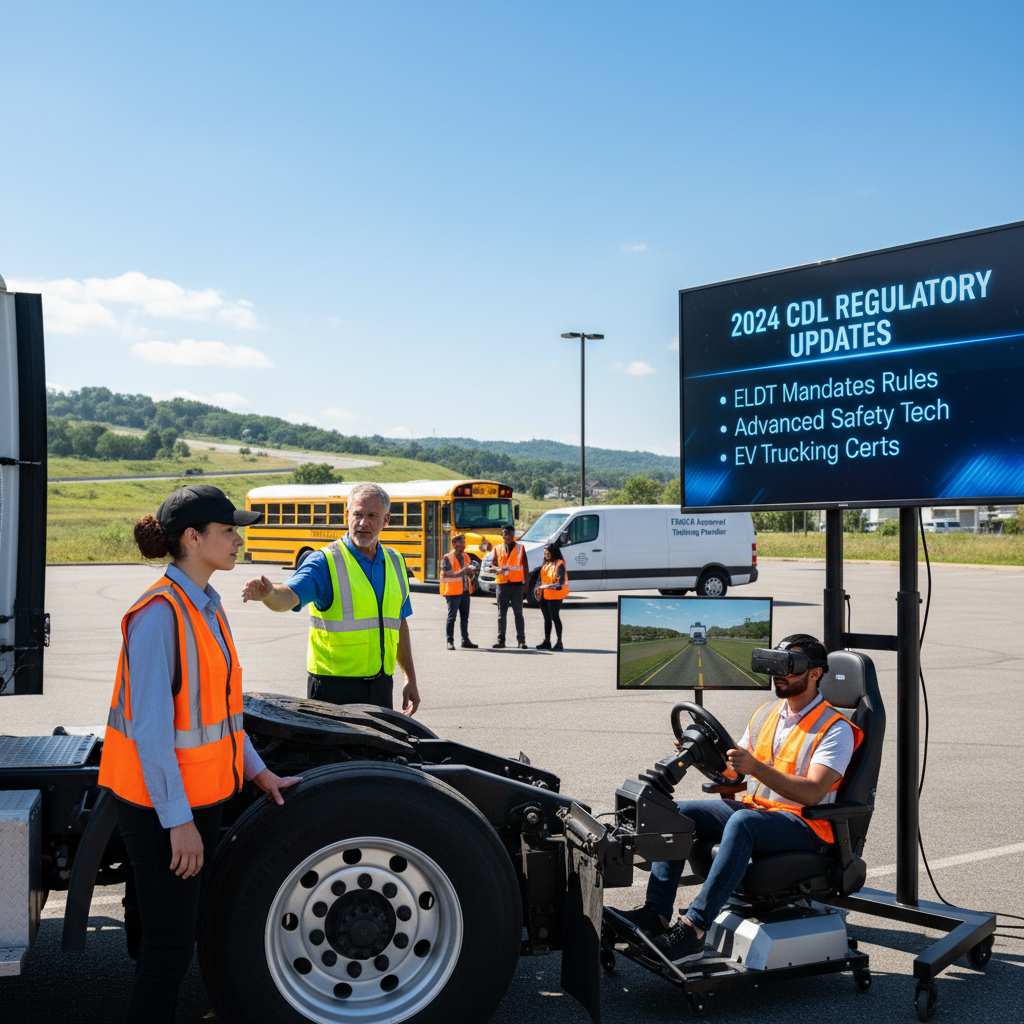
The 2024 revisions introduce technological enhancements such as driving simulators to provide a more accurate and comprehensive evaluation of driver abilities. Additionally, alternative testing methods will be available, allowing drivers to demonstrate their skills through different formats. This flexibility is intended to accommodate diverse driver needs and reduce barriers in the testing process, ultimately expediting CDL issuance.
Third-Party Knowledge Examiners and Testers
The Federal Motor Carrier Safety Administration (FMCSA) continues to expand the role of third-party knowledge examiners and testers in administering CDL knowledge exams. As of recent regulatory proposals, third-party knowledge examiners—individuals employed by authorized third-party knowledge testers such as private training facilities or local government agencies—are formally defined and regulated. They are now required to meet the same training, certification, and record-keeping standards as State knowledge examiners. Likewise, third-party knowledge testers must adhere to auditing and monitoring requirements comparable to those for third-party skills testers. These measures aim to enhance the integrity and efficiency of CDL knowledge testing nationwide.
Regulatory Background and Compliance
The 2024 updates build upon previous federal rules, including the 2011 FMCSA final rule that established minimum standards for CDL knowledge and skills testing and the issuance of Commercial Learner’s Permits (CLPs). The current revisions also respond to petitions from industry groups such as the American Trucking Associations (ATA) seeking to codify waivers and modernize testing in light of recent challenges, including those posed by the COVID-19 pandemic.
By aligning third-party testing practices with federal standards and leveraging modern technology and flexible testing approaches, the 2024 CDL testing procedures strive to balance safety, fairness, and efficiency for all commercial driver candidates.
Regulations and Compliance
The Federal Motor Carrier Safety Administration (FMCSA) has implemented and continues to update a comprehensive regulatory framework governing Commercial Driver’s License (CDL) training and compliance to ensure safety and integrity in the issuance and administration of CDLs. Central to this framework are the Entry-Level Driver Training (ELDT) regulations, which establish minimum federal training requirements for entry-level drivers seeking to obtain a Class A or Class B CDL for the first time.
Under the ELDT regulations, all training providers—including public and private CDL training schools, motor carriers, educational institutions, and individuals—must register with the FMCSA’s Training Provider Registry (TPR) and self-certify compliance with the prescribed training curricula as outlined in 49 CFR Part 380 Appendices A through E. Training providers may operate on either a for-hire or not-for-hire basis, but must meet all applicable federal, state, and local laws. This registry enables prospective drivers to identify eligible training programs prior to taking the CDL skills test.
In response to petitions from the American Trucking Associations (ATA) and the New Hampshire Department of Transportation (NHDOT), FMCSA has proposed regulatory changes to enhance the efficiency and integrity of the CDL knowledge testing process. These include defining “third-party knowledge examiner” and “third-party knowledge tester,” and subjecting third-party knowledge examiners to the same training, certification, auditing, and monitoring standards as state examiners. This shift reflects a change from prior guidance, allowing States more flexibility to permit third-party examiners to administer knowledge tests while maintaining program integrity.
Moreover, FMCSA continuously evaluates its regulatory impact and aligns its rulemaking with executive orders aimed at improving regulatory planning and review, such as E.O. 12866, E.O. 13563, and E.O. 14094, ensuring that updates promote safety without unnecessary burdens.
States maintain flexibility to impose additional CDL requirements tailored to regional needs, resulting in varied approaches across the country. For instance, Florida has emphasized weather-related training, whereas Texas focuses on industry-specific concerns like oil and gas. Compliance with such state-specific regulations is enforced through inspections and audits to ensure driver and carrier adherence.
Despite these regulatory measures, concerns about enforcement remain. In April 2025, the Commercial Vehicle Training Association (CVTA) and the National Association of Publicly Funded Truck Driving Schools (NAPFTDS) urged federal officials to strengthen enforcement of the Training Provider Registry requirements, highlighting that since 2023, only four noncompliant providers had been removed, while numerous others remained flagged without action.
Finally, FMCSA has also addressed regulatory relief and adaptations in response to emergencies and public health crises, such as provisions that create automatic exemptions during declared emergencies and amendments to facilitate CDL issuance and renewal processes for non-domiciled individuals, reflecting a balance between flexibility and regulatory integrity.
Employment Trends and Job Opportunities (2024)
The trucking industry in 2024 is experiencing a mix of challenges and promising opportunities for current and aspiring
Specialized Skills and Endorsements in Demand
Obtaining specialized endorsements on a Commercial Driver’s License (CDL) significantly enhances a driver’s qualifications and potential earning power. Among the most sought-after endorsements is the HazMat endorsement, often combined with the Tanker endorsement to form the “X” endorsement. This combo endorsement permits Class A and B CDL holders to haul hazardous materials via tanker trucks, including substances such as gas, oil, and other potentially dangerous chemicals. While having the “X” endorsement grants the ability to handle both tanker and HazMat freight, it does not obligate drivers to haul hazardous materials if they choose not to.
To operate a tanker truck, all drivers must obtain the tanker endorsement prior to employment, and companies like Schneider require applicants for tanker positions to already possess this endorsement at the time of hire. Although some employers do not mandate the combination endorsement or reimburse drivers for acquiring it, possessing additional endorsements can open doors to specialized driving opportunities and often lead to higher wages.
Drivers with endorsements and specialized skills are typically compensated based on mileage driven, with per-mile rates varying according to the employer, cargo type, and driver experience. As drivers gain experience and add endorsements such as HazMat or tanker, their earning potential increases. For instance, the median annual wage for heavy and tractor-trailer truck drivers was approximately $93,305 as of March 2026, reflecting the value of specialization within the industry.
The trucking industry has seen positive growth and recovery trends recently, which, combined with less market competition, may contribute to better pay and improved policies aimed at retaining qualified drivers with specialized skills and endorsements. Consequently, pursuing endorsements and developing expertise in specialized freight hauling remains a valuable strategy for drivers seeking rewarding careers in the CDL field.
Choosing a CDL Training Program
When selecting a Commercial Driver’s License (CDL) training program, prospective drivers should consider several critical factors to ensure the program meets their needs and complies with federal regulations. CDL training programs are generally categorized into licensed, certified, or accredited types. Licensed schools have been reviewed by state agencies and must meet minimum requirements related to facilities, curriculum, instructors, and financial stability, which can provide some assurance of program quality.
One common model involves employer-sponsored training, where drivers agree to work for the carrier for a set period, often at least one year, in exchange for the training. While this arrangement often guarantees employment upon completion and meeting hiring criteria, there may be tuition reimbursement costs or penalties if the trainee fails to fulfill the employment obligation. In contrast, truck driving schools and community colleges typically offer more structured curricula that span several weeks to months, with some programs including a mix of classroom instruction and driving practice totaling around 160 hours.
Flexibility is another important consideration. Some programs offer part-time attendance or online theoretical coursework, allowing students to progress at their own pace while completing mandatory in-person skills training. However, attending classes part-time can extend the overall time required to obtain a CDL.
It is also crucial for training programs to follow the Federal Motor Carrier Safety Administration’s (FMCSA) Entry-Level Driver Training (ELDT) requirements to ensure compliance and prepare students adequately. Programs that adhere to FMCSA standards often utilize comprehensive, customizable curricula that emphasize mastery of both theoretical knowledge and practical maneuvers, moving beyond mere checklist compliance. Training providers must also maintain robust documentation processes and meet drug and alcohol testing regulations under 49 CFR Part 382.
Lastly, prospective students should review their state’s specific CDL training requirements, as these vary and influence program eligibility and licensing procedures. Links to state manuals and regulatory guidelines are typically available to help applicants understand local mandates.
Choosing the right CDL training program is a balance of program quality, regulatory compliance, flexibility, and employment opportunities. Given the ongoing driver shortage and high industry turnover rates, well-structured training programs can provide a pathway not only to a CDL but also to stable employment and career advancement.
Resources and Support for CDL Trainees
Commercial Driver’s License (CDL) trainees have access to a variety of resources and support systems designed to ensure comprehensive training and compliance with federal and state regulations. A key resource is the modernized CDL Training Handbook, which provides updated guidelines and structured curricula that help instructors deliver high-quality education while maintaining operational efficiency. These handbooks include detailed instructions on new training programs, testing procedures, and compliance requirements, making them essential for both CDL holders and trucking companies to meet state-specific regulations.
Training providers play a critical role by submitting certification completions to the Federal Motor Carrier Safety Administration (FMCSA) through the Training Provider Registry, an important step to verify that entry-level driver training requirements have been met. To support schools and instructors, there are comprehensive guides covering FMCSA compliance aspects such as Training Provider Registry (TPR) registration, Entry-Level Driver Training (ELDT) curriculum standards, behind-the-wheel training, and recordkeeping, with additional emphasis on state-specific rules.
Prospective instructors and trainees should be aware that certain endorsements or specialized training might involve extra requirements, such as background checks, medical certifications, or specific driving experience in the relevant vehicle class. For the most current certification requirements and application procedures, contacting the local Department of Motor Vehicles (DMV) is advised, as regulations can vary by state.
Furthermore, FMCSA has proposed regulations to enhance the integrity and efficiency of CDL knowledge testing, particularly concerning third-party examiners. These proposals include subjecting third-party knowledge testers to the same training, certification, auditing, and monitoring standards as state examiners, which helps maintain the quality and security of CDL testing processes.
In addition to regulatory and instructional resources, trainees can access specialized courses covering related safety and operational topics, such as drug and alcohol training, confined space safety, and driver safety protocols, which are offered by various certified providers. This comprehensive support infrastructure aims to prepare CDL trainees not only to pass their exams but also to operate commercial vehicles safely and responsibly in diverse conditions.
Recent Changes and Trends in CDL Training (This Year)
Commercial driver’s license (CDL) training has seen significant updates and evolving trends this year, driven by regulatory changes, technological advancements, and increased funding to enhance safety and compliance across the United States. The Federal Motor Carrier Safety Administration (FMCSA) has been actively modernizing regulatory frameworks to improve the quality and consistency of CDL training programs.
One of the key developments involves the integration of progress tracking systems within training modules. These systems allow instructors to monitor student advancement in real time, identifying areas where additional support is needed and ensuring that learners meet proficiency benchmarks before progressing. This approach has been shown to increase student engagement and improve outcomes by allowing timely interventions and customized instruction. Additionally, CDL schools benefit from customizable content that can be tailored to specific training priorities, such as specialized vehicle operations or updated regulatory requirements, streamlining compliance with FMCSA standards.
Financially, the FMCSA has significantly increased grant funding to support CDL program implementation and compliance efforts. In 2024, approximately $89.4 million in grants became available, up from $55.1 million awarded in 2023. These funds aim to help states and training providers strengthen safety regulations, improve program integrity, and promote diversity and inclusion through targeted recruitment and outreach to underserved communities.
At the state level, responses to recent federal regulatory changes vary. For example, Pennsylvania has paused the issuance and renewal of non-domiciled CDLs and commercial learner’s permits (CLPs) as it reviews the economic and administrative impacts of the new federal rules. This cautious approach reflects ongoing negotiations between state departments of transportation and federal agencies to align with the updated standards without disrupting existing operations.
Training curricula have also evolved to include comprehensive modules on specialized endorsements such as Hazardous Materials (Hazmat), Doubles/Triples, and Tanker operations. For instance, Illinois offers a rigorous 196-hour program designed to prepare students thoroughly for both state endorsement exams and safe driving practices, reflecting a broader trend toward more intensive and specialized CDL instruction.