
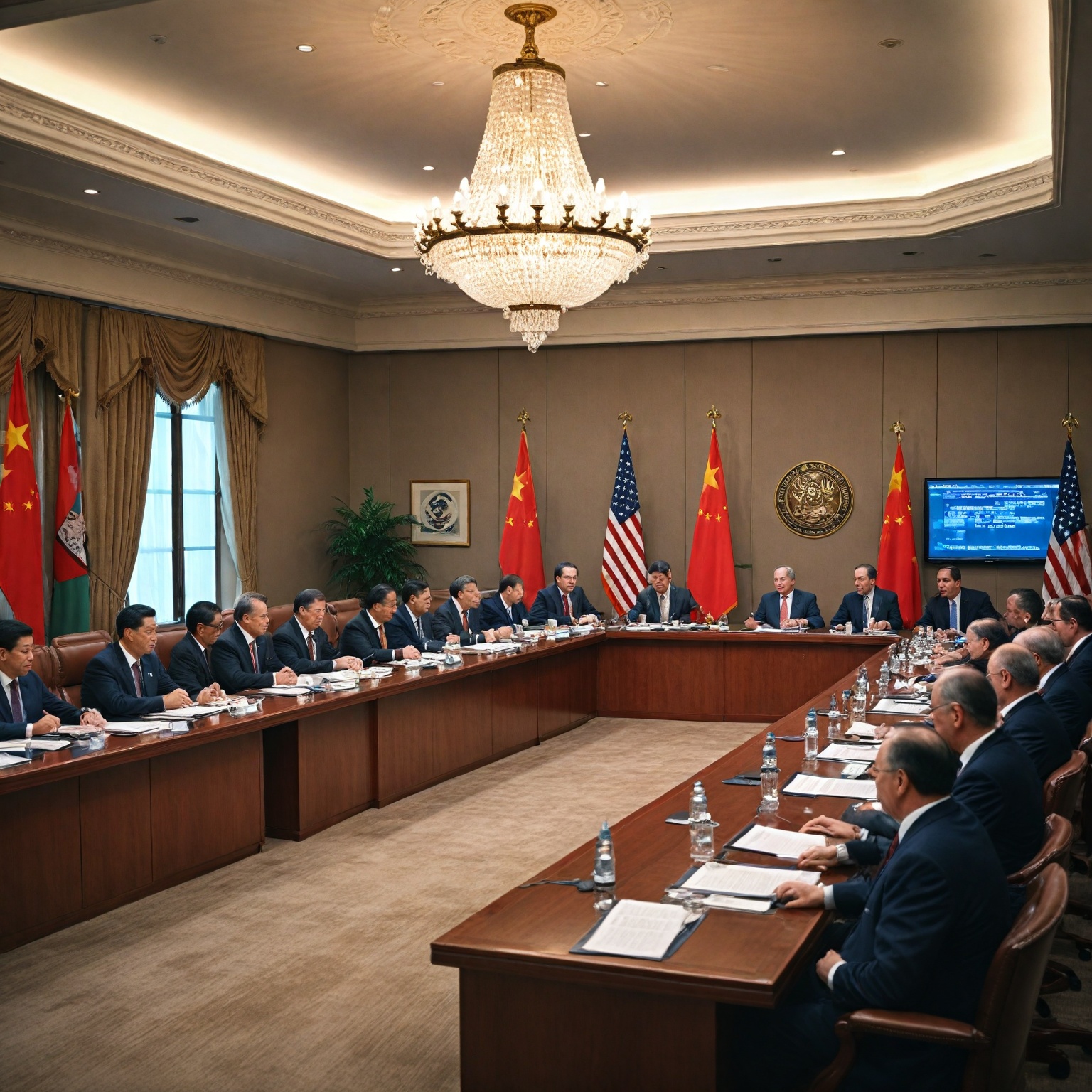
Highlights:
– U.S. Treasury Secretary Bessent sees a pivotal opportunity for a significant trade agreement that could redefine the economic relationship between the U.S. and China, emphasizing a shift towards sustainable practices and domestic-focused growth strategies.
– Bessent advocates for a comprehensive trade deal addressing key issues like trade imbalances, tariff reductions, intellectual property protections, and market access, highlighting the potential for global economic stability and growth with the right agreement in place.
– Despite challenges, Bessent's call for candid dialogue, informal channels, and political will underscores the critical nature of finding common ground and committing to mutual benefits in navigating the complexities of U.S.-China trade relations and shaping international economic governance.
Summary
The trade relationship between the United States and China has been marked by significant tensions since the onset of the trade war during President Donald Trump’s administration, involving tariffs, counter-tariffs, and regulatory disputes that have reshaped global supply chains and affected hundreds of billions of dollars in bilateral trade. U.S. Treasury Secretary Scott K. H. Bessent, sworn in in 2025, has characterized the current situation as unsustainable but sees a notable opportunity for a major trade agreement that could rebalance economic relations between the two largest economies in the world. He envisions a deal that would encourage increased U.S. manufacturing and reduced consumption, while prompting China to shift from an export-driven growth model to one more focused on domestic demand.
Bessent’s advocacy for a “big deal” emphasizes addressing longstanding trade imbalances, tariff reductions, enhanced market access for U.S. goods, intellectual property protections, and the resolution of non-tariff barriers, which have been central points of contention. Despite the economic disruptions caused by the trade war—including slowed growth, disrupted supply chains, and shifts in global manufacturing—the two countries remain deeply interdependent, and a comprehensive agreement could have significant benefits for global economic stability and growth. Bessent has also promoted the use of informal diplomatic channels to facilitate candid dialogue and expedite negotiations ahead of formal meetings.
However, the path to agreement faces substantial challenges, including entrenched positions on tariffs, concerns about national economic security, and the complexity of structural economic adjustments required on both sides. While progress has been noted in talks with other trading partners such as India, negotiations with China remain particularly difficult due to its increased bargaining power and the scale of economic rebalancing involved. The possibility of a complete economic decoupling is widely regarded as unlikely, though tensions and uncertainties persist.
Treasury Secretary Bessent’s remarks reflect cautious optimism amid this complex landscape, highlighting the importance of political will and mutual commitment to overcome obstacles and seize the opportunity for a transformative trade deal. His position underscores the broader implications of U.S.-China trade relations not only for bilateral interests but also for global economic governance, calling for renewed focus by international financial institutions on economic stability and pragmatic cooperation.
Background
The trade relationship between the United States and China has experienced significant tensions since the onset of the trade war initiated during President Donald Trump’s first administration. This conflict led to the imposition of tariffs and counter-tariffs, affecting billions of dollars in goods and reshaping global supply chains. By 2018, U.S.-bound exports accounted for 19.8% of China’s total exports; however, this figure declined to 12.8% by 2023, reflecting the growing economic friction and China’s strategic shift towards expanding domestic demand to strengthen its internal economy.
U.S. Treasury Secretary Scott Bessent has highlighted that intentional policy decisions by other countries have eroded America’s manufacturing sector and critical supply chains, thereby threatening national and economic security. He emphasized that the status quo of persistent trade imbalances is unsustainable for both the United States and its trading partners. The Trump administration’s approach focused not only on tariff levels but also targeted non-tariff barriers such as currency manipulation and value-added taxes, aiming to create fairer trade conditions and encourage the reshoring of manufacturing to the U.S.
Despite the trade war’s intended effects, China managed to withstand economic pressures with minimal damage, even bolstering confidence in its economic prospects. Some economists predict that tariff hikes could paradoxically increase China’s exports to the U.S. over the mid- to long-term. The trade war also led many American companies to shift supply chains to other parts of Asia, raising concerns about a potential economic decoupling between the two largest economies, though complete decoupling is considered unlikely by experts.
Negotiations have been ongoing to de-escalate the conflict and restore tariff certainty. Bessent noted progress in talks with multiple countries, including India, where trade barriers are predominantly high tariffs without complex non-tariff measures, facilitating closer agreements. The Trump administration has sought to lower foreign tariff rates for American exporters, improve market access, and strengthen trade rules to align with U.S. economic security goals.
Bessent also expressed optimism about a potential “big deal” with China that would involve mutual rebalancing toward more manufacturing and less consumption, contingent upon China’s commitment to shifting from export-led growth to domestic economic expansion. He suggested that such cooperation could benefit both countries and called for international financial institutions like the IMF and World Bank to refocus on core economic stability rather than peripheral social issues. Informal envoys from the White House have been utilized to facilitate candid dialogue between Washington and Beijing, aiming to accelerate trade negotiations ahead of formal meetings between leaders.
Treasury Secretary Scott K. H. Bessent
Scott Kenneth Homer Bessent, sworn in on January 28, 2025, as the 79th United States Secretary of the Treasury, is an American government official, investor, and hedge fund manager. Prior to his appointment, Bessent was a partner at Soros Fund Management and served as managing partner of its London office from 1991 to 2000. Additionally, he taught economic history as an adjunct professor at Yale University.
As Treasury Secretary, Bessent is responsible for overseeing the Treasury’s mission to maintain a strong economy, foster economic growth, and create job opportunities across the United States by promoting conditions for prosperity domestically and internationally, while managing the U.S. Government’s finances. In his public remarks, Bessent has frequently addressed the ongoing U.S.-China trade tensions, emphasizing both the challenges and opportunities in the relationship.
Bessent has acknowledged that the trade war between the U.S. and China has led to significant economic disruptions, including a slowdown in China’s economic and industrial growth, and concerns over a potential decoupling of the two economies as American companies relocate supply chains elsewhere in Asia. He has described negotiations with China as a “slog,” recognizing that neither side views the current status quo as sustainable.
Despite the difficulties, Bessent remains optimistic about the possibility of a significant trade agreement. He stated, “There is an opportunity for a big deal here” regarding trade issues between the two countries. Bessent envisions a rebalancing where the U.S. shifts toward more manufacturing and less consumption, and China moves toward reducing its dependence on export-led growth while strengthening its domestic economy. He indicated that if China is sincere about such a rebalancing, the two nations could collaborate to achieve it.
Bessent’s comments come amid shifting trade dynamics; for example, China’s exports to the U.S. fell from 19.8% of total exports in 2018 to 12.8% in 2023, partly as a result of tariffs and the trade war. He has expressed that the current tensions are “not a joke” and expects a de-escalation of the trade conflict, highlighting a cautious but hopeful outlook for future negotiations.
Throughout his tenure, Bessent has also underscored the potential role of informal envoys in facilitating more flexible and candid negotiations with Chinese authorities, a strategy that may complement official diplomatic efforts to expedite trade talks.
Details of the Proposed Trade Deal Opportunity
U.S. Treasury Secretary Scott Bessent has emphasized the potential for a significant trade agreement between the United States and China, highlighting an opportunity to address longstanding trade issues and rebalance economic relations between the two largest global economies. Speaking at multiple forums in early 2025, Bessent described the current trade tensions, including tariffs and regulatory barriers, as unsustainable and anticipated a de-escalation of the ongoing trade war.
The proposed trade deal aims to tackle several critical areas to enhance market access and economic cooperation. Key objectives include lowering foreign tariff rates on American exports, improving transparency and predictability within foreign regulatory systems, and expanding market access for U.S. agricultural products. Additionally, the deal would strengthen rules of origin provisions to ensure that the benefits of the agreement are fairly allocated to participating parties, thereby preventing circumvention through third-party inputs.
Bessent underscored that the deal would support the U.S. strategy to rebalance its economy towards increased manufacturing and reduced consumption, while aligning with China’s expressed goal to shift from export-led growth to strengthening its domestic economy. He suggested that if China is genuinely committed to rebalancing its economy, the United States is willing to collaborate on this transition, framing it as a shared opportunity for mutual economic adjustment and growth.
This opportunity for a “big deal” is seen not only as a path to reduce trade barriers but also as a strategic alignment on economic security and non-market practices. The negotiation process is expected to be faster than the overall rebalancing timeline, which Bessent estimates to span two to three years. The deal would address structural issues including forced technology transfer, intellectual property protections, non-tariff barriers, and cyber-related concerns, which have been major sticking points in past trade negotiations.
Given the enormous scale of trade between the U.S. and China—amounting to over $580 billion in goods trade in 2024—the potential benefits of a comprehensive agreement are significant. The two countries together represent nearly half of global manufacturing output and a substantial share of global GDP, making the resolution of trade disputes critical not only for bilateral relations but for the broader global economy.
Economic Sectors Impacted by the Potential Agreement
The potential trade agreement between the United States and China is poised to significantly affect multiple economic sectors in both countries, reflecting their deep interdependence and the ongoing efforts to rebalance their economies.
One of the primary sectors impacted would be manufacturing. The United States is seeking to rebalance its economy towards increased manufacturing output, moving away from an identity centered on consumption. This shift aligns with China’s stated intention to reduce its dependence on export-led manufacturing growth and pivot towards a more domestically driven economy. If both countries collaborate on this transition, it could lead to a realignment of global manufacturing patterns and supply chains.
China’s manufacturing sector has historically played a critical role in the global economy, assembling products for export using components sourced worldwide. This has resulted in China becoming the largest manufacturing hub globally, accounting for nearly 48 percent of global manufacturing output as of 2023. The U.S.-China trade relationship is deeply intertwined with this manufacturing ecosystem, with China serving as a key export market for U.S. goods and the United States as China’s top export destination.
The potential agreement also has implications for intellectual property (IP) and innovation sectors. Past trade tensions stemmed largely from concerns over China’s practices regarding intellectual property rights, which have been estimated to cost the U.S. economy between $225 billion and $600 billion annually due to IP theft. Addressing these issues remains central to creating a fairer and more balanced trade relationship, potentially benefiting U.S. innovation competitiveness and reducing economic coercion.
Broader Context of US-China Trade Negotiations
Treasury Secretary Scott Bessent has emphasized that the ongoing trade tensions between the United States and China present a significant opportunity for a substantial trade deal. He highlighted that the situation is “not a joke” and stressed the importance of “impetus and will” to advance negotiations, indicating optimism about de-escalation amid current challenges. Bessent also called on international financial institutions like the IMF and the World Bank to refocus on their core missions of economic stability and development, rather than expanding into broader social issues, which he suggested had detracted from addressing fundamental economic concerns.
Unlike the initial phase of the U.S.-China trade conflict during President Trump’s first term, when China appeared eager to negotiate, the current dynamic reflects a shift in leverage. China now holds considerably more bargaining power, making the path to agreement more complex. This evolving balance of power influences the nature and pace of negotiations, with both sides weighing economic and strategic priorities.
The broader negotiation landscape includes efforts to reduce barriers for U.S. exporters, enhance transparency and predictability in foreign regulatory regimes, improve market access for American agricultural products, and align trading partners with U.S. approaches to economic security and non-market policies. These initiatives aim to establish more reciprocal trade relationships and ensure that benefits flow equitably among parties.
The Biden administration, with input from trusted informal envoys, has explored flexible and candid dialogues with Chinese authorities as a means to lay the groundwork for higher-level trade discussions. This approach seeks to circumvent the rigidity of formal diplomatic channels and accelerate progress toward mutually beneficial agreements. Meanwhile, the White House maintains that the responsibility to advance these talks lies with China, reflecting a strategic posture that encourages Beijing to take the lead in negotiations.
Reactions and Responses
The potential for a significant trade deal between the United States and China has elicited varied reactions from policymakers, industry leaders, and governments on both sides. Treasury Secretary Bessent highlighted an opportunity for collaboration, noting that the U.S. is seeking to rebalance its economy toward increased manufacturing and reduced consumption. He suggested that if China genuinely intends to shift away from an export-led growth model to a more domestic-oriented economy, then both countries could pursue a mutually beneficial agreement.
However, tensions remain high due to ongoing tariff disputes and retaliatory measures. The U.S. threatened tariffs on an additional $267 billion worth of Chinese imports, prompting China to impose 10% tariffs on $60 billion of American goods. Altogether, China has enacted or proposed tariffs affecting $110 billion of U.S. exports, impacting key industries and disrupting supply chains. This trade conflict has slowed economic growth and industrial output in China and led many American companies to relocate manufacturing operations to other Asian countries. These developments have raised concerns about a potential economic “decoupling” between the two largest global economies, which together represent nearly half of global GDP and manufacturing output.
On the U.S. side, the trade war has also generated political and economic debates. White House National Trade Council director Peter Navarro accused certain Wall Street billionaires of undermining the president’s negotiating position by supporting Chinese interests, urging investment in struggling U.S. regions such as the Rust Belt. Meanwhile, efforts to negotiate new trade agreements focus on reducing foreign tariff rates for American exporters, improving regulatory transparency, and enhancing market access, especially for U.S. agricultural products. These initiatives aim to align international trade practices with U.S. economic security concerns and ensure that the benefits of trade agreements accrue fairly to all parties involved.
From China’s perspective, the government maintains that the U.S. initiated the trade war with the intention of suppressing China’s economic rise. Chinese officials argue that the conflict has caused negative effects globally and complicated negotiations, emphasizing that the real goal behind U.S. actions is to hinder China’s growth rather than achieve equitable trade outcomes. Despite these challenges, experts generally agree that a complete decoupling of the two economies is unlikely, given their deep interdependence and the scale of their combined economic influence.
Challenges and Obstacles to Agreement
The negotiation process between the United States and China faces significant challenges, with both sides recognizing that the current status quo is unsustainable but struggling to find common ground. U.S. Treasury Secretary Scott Bessent described the negotiations as a “slog,” emphasizing the complexity and difficulty in reaching an agreement given the entrenched positions and deep economic differences between the two countries.
One major obstacle is the extensive tariff standoff that has escalated tensions and created uncertainty among global investors and markets. The implementation of global tariffs, followed by partial reprieves, has complicated the economic landscape, making it harder for both sides to move swiftly toward a resolution. The ongoing trade war has raised concerns about the reliability of key markets, including the U.S. Treasury market, which is a critical pillar of global finance.
Underlying these negotiations are broader structural issues, including intentional policy choices by various countries that have hollowed out the U.S. manufacturing sector and undermined critical supply chains, thereby affecting national and economic security. Addressing these systemic imbalances is fundamental to any sustainable agreement, but it also adds layers of complexity to the talks.
Furthermore, while the U.S. is engaging in negotiations with multiple countries to restore tariff certainty and improve market access—highlighting progress in
Future Outlook
U.S. Treasury Secretary Scott Bessent has expressed cautious optimism about the potential for a significant trade agreement between the United States and China. Speaking at the Institute of International Finance Global Outlook Forum in April 2025, Bessent described the upcoming negotiations as an “incredible opportunity” for a “big deal,” contingent on China’s willingness to shift away from an economy heavily reliant on manufacturing exports toward greater domestic consumption and economic rebalancing. He emphasized that this change is necessary not only for China but also for the U.S., indicating mutual benefits in achieving a more balanced trade relationship.
Bessent underscored that the success of such a deal depends largely on the “impetus and will” of both countries to engage constructively in negotiations. He anticipates that several large countries with substantial trade deficits might soon participate actively in trade talks, potentially leading to favorable agreements if they bring forward solid proposals. In parallel, he noted that negotiations with India were progressing rapidly due to the relatively straightforward nature of trade barriers, suggesting a broader strategy of engaging multiple trading partners to rebalance U.S. trade relationships.
Despite the optimism, Bessent acknowledged that talks with China had not yet formally begun and predicted that negotiations would be a challenging and prolonged process. He clarified that the previously mentioned two- to three-year timeframe referred to the comprehensive economic rebalancing, rather than the duration of negotiations themselves, which he expects to unfold more swiftly. The trade war that commenced in 2018 has already influenced trade dynamics, with U.S.-bound exports from China declining significantly from 19.8% of total exports in 2018 to 12.8% in 2023, prompting China to focus on expanding its domestic demand to mitigate the impact of tariffs.
Experts suggest that although tensions remain high and the idea of a complete economic decoupling is unlikely, the evolving economic landscape and mutual dependencies mean that both nations have incentives to reach some form of agreement. However, the challenges posed by conflicting interests and complex trade barriers indicate that progress will require sustained effort and compromise from both sides.
The content is provided by Blake Sterling, Scopewires


