
Highlights
- Electric scaffolding lifts significantly enhance worker safety and operational efficiency in elevated tasks.
- These lifts support sustainable construction by reducing emissions and aligning with evolving safety regulations.
Summary and Overview
Electric scaffolding lifts are battery-powered platforms designed to improve safety, efficiency, and mobility in elevated construction and maintenance work. Complying with OSHA standards, they feature automated lifting, modular designs, and real-time safety systems that reduce physical strain and hazards like falls and electrocution. Their versatility allows rapid deployment in various settings, enhancing productivity and adherence to safety regulations. Environmentally, they offer quieter, emission-free operation, though their sustainability depends on energy sources and material lifecycle management. Challenges include regulatory complexity, outdoor limitations, and the need for thorough operator training. Innovations focus on improved safety monitoring, hybrid power options, and modularity to advance these platforms.
Design, Safety Features, and Worker Protection
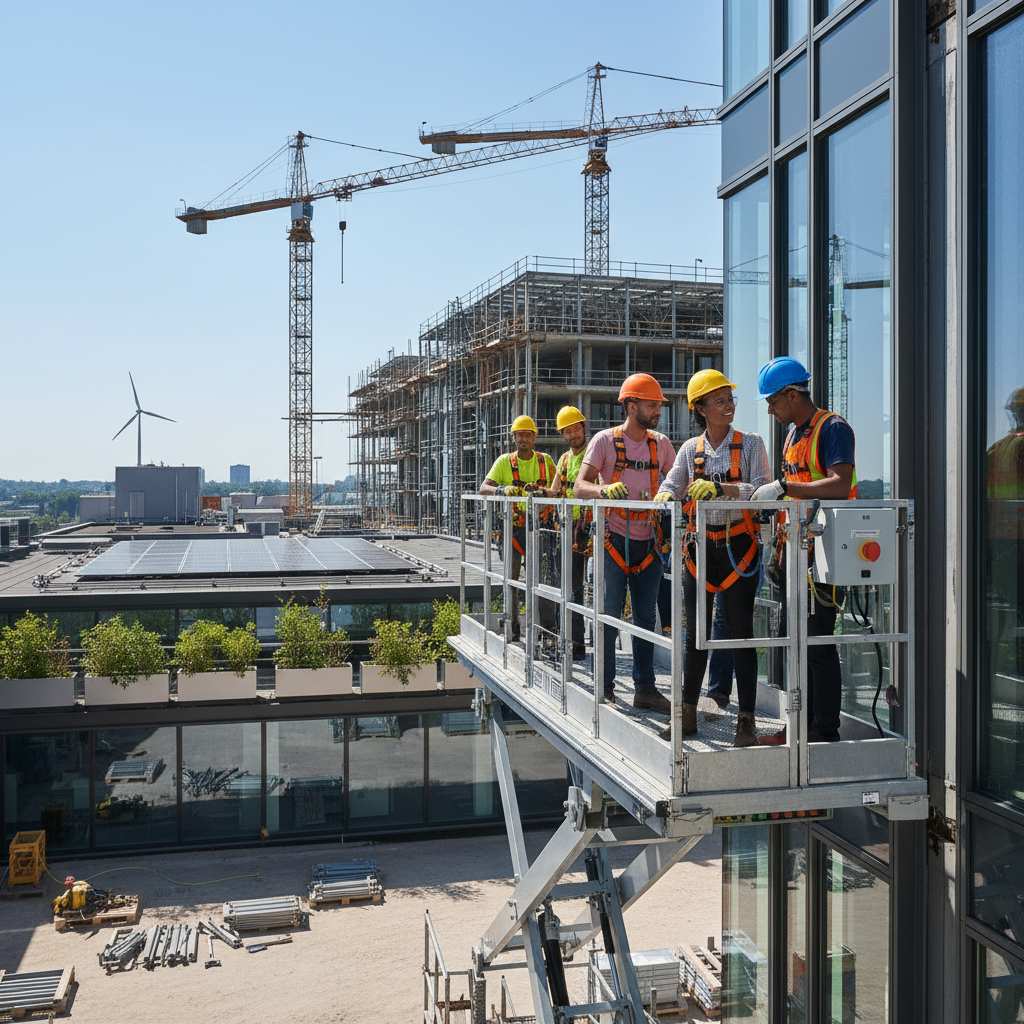
Constructed from industrial-grade carbon steel and lightweight aluminum modules, electric scaffolding lifts combine robust support with easy assembly. Automated, remotely controlled lifting and 180-degree swivel platforms increase precision and safety by minimizing time spent at height. Safety features include guardrails, personal fall arrest systems (PFAS), emergency stop switches, overload protection, and speed governors. Electrical hazards are addressed through PPE, training, and compliance with OSHA lockout/tagout procedures. Overhead protective structures and exclusion zones reduce risks from falling objects. Regular maintenance and operator training are essential to prevent accidents, ensuring safer elevated work environments.
Operational Efficiency and Productivity
Electric scaffolding lifts enhance productivity by reducing manual labor through automated, remote-controlled mechanisms and intuitive electric controls. Their mobility and 180-degree swivel capability facilitate quick installation and repositioning across diverse sites, from construction to industrial maintenance. Advanced emergency stop systems with real-time monitoring improve responsiveness and minimize downtime. Proper training and regular maintenance uphold safety and reliability, making these lifts efficient tools for demanding elevated tasks.
Environmental Impact and Sustainability
These lifts support sustainable construction by eliminating direct emissions and reducing noise pollution compared to fuel-powered equipment. Made from recyclable steel and aluminum, their environmental footprint depends on energy sources used for charging and lifecycle management. Electric lifts contribute to lowering carbon emissions and operational energy use on site, especially when powered by renewable energy. Extending their service life further improves environmental benefits.
Applications and Safety Hazards Addressed
Electric scaffolding lifts are used in construction, renovation, industrial cleaning, and event setups for tasks like painting, window installation, electrical work, and maintenance. Their quiet operation suits indoor and sensitive environments. Safety hazards addressed include fall prevention via PFAS and guardrails, electrical shock mitigation through training and PPE, and protection against falling objects with containment screens and exclusion zones. Firm scaffold foundations and proper housekeeping minimize collapse, slips, and trips. Compliance with OSHA standards and comprehensive training ensure safe operation.
Comparative Analysis
Compared to traditional scaffolding, electric scaffolding lifts offer faster setup, reduced manual labor, and enhanced safety through automatic leveling and stability controls. They comply with OSHA regulations and provide safer alternatives to ladders and conventional scaffolds. Environmentally, electric lifts produce no tailpipe emissions and less noise pollution, outperforming hydraulic and fuel-powered lifts in eco-friendliness and operational efficiency.
Challenges and Future Trends
Despite benefits, electric scaffolding lifts face challenges such as regulatory compliance, limited outdoor use, and the need for operator training to manage electrical hazards. Future developments aim to enhance safety with real-time monitoring, expand hybrid power systems for varied conditions, and improve modular lightweight designs. These innovations seek to broaden applicability while maintaining environmental and operational advantages.
Research and Safety Outcomes
Case studies affirm electric scaffolding lifts improve efficiency and safety over traditional models. OSHA enforces strict standards to mitigate risks including falls, electrocution, and structural failures. Preventative measures involve hazard assessments, PPE use, equipment inspections, and comprehensive training. Regulatory updates reflect ongoing efforts to enhance worker protection, supported by statistical data on scaffold-related incidents.
The content is provided by Sierra Knightley, Scopewires


