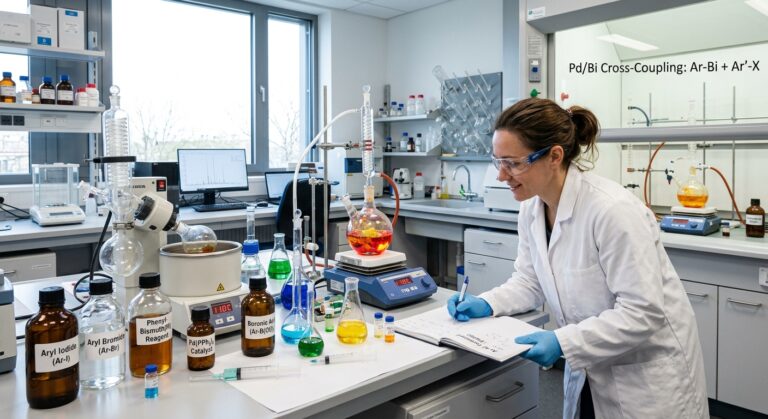

Overview of Aryl-Bismuth Reagents
Aryl-bismuth reagents introduce a unique approach in carbon–carbon bond formation by acting dually as nucleophiles and electrophiles within the same reaction. This capability challenges traditional norms where reagents are limited to specific roles in reactions, allowing for more versatile synthetic designs. Their ambiphilic nature increases the compatibility with various substrates, potentially simplifying the synthesis process while retaining high selectivity.
Structure and Properties
These reagents are characterized by heteroatom-bridged bis(aryl) ligands that provide both stability and flexibility, essential for their dual functionality. Their electronic characteristics, including planar Bi(III) centers with vacant orbitals, facilitate high reactivity. This design allows for both oxidative addition and transmetalation without necessitating external oxidants, effectively broadening their application scope.
Synthesis of Aryl-Bismuth Reagents
Synthesizing aryl-bismuth reagents involves multistep processes optimizing ligand frameworks to enhance their reactive capabilities. Convergent strategies for N,C,N-pincer aryl-bismuth compounds enable tailored electronic properties essential for efficient applications. Systematic variation of aryl groups and ligands during synthesis allows researchers to explore their dual reactivity in diverse catalytic conditions effectively.
Mechanism of Action
The mechanism utilizing aryl-bismuth reagents diverges from traditional cross-coupling pathways. They can engage in oxidative addition to Pd(0) or transmetalation to Pd(II), depending on the presence of specific coupling partners. This flexibility reduces restrictions imposed by polarity, enabling diverse coupling reactions under mild conditions while minimizing side reactions commonly seen with conventional reagents.
Catalysts and Conditions
Utilizing organobismuth catalysts introduces distinct reactivity profiles beneficial for various functional groups. These catalysts not only demonstrate compatibility with sensitive functionalities but also can facilitate reactions without modifying bismuth’s oxidation state. Reaction conditions often favor mild oxidative environments that maximize yields while ensuring broad substrate compatibility, including biologically relevant compounds.
Applications in Synthesis
Aryl-bismuth reagents provide a transformative approach to synthetic methodologies, intensifying efficiency in cross-coupling reactions. Their dual reactivity expands the accessibility of biaryl and polyaryl frameworks, offering chemists enhanced selectivity and flexibility in synthetic applications. This versatility simplifies reaction designs, allowing for higher yields and broader compatibility compared to traditional aryl reagents.
Advantages and Challenges
The ambiphilic nature of aryl-bismuth reagents offers significant benefits, including increased synthetic flexibility and wider applicability. However, some limitations include variable yields under certain conditions, necessitating further optimization. As research progresses, a deeper understanding of reaction parameters will help overcome these challenges, enhancing their practical utility in synthetic endeavors.
Future Directions
Ongoing research on aryl-bismuth reagents aims to refine their synthetic applications and broaden the understanding of their mechanistic pathways. By exploring new ligand designs and structural modifications, there is potential for developing greener methodologies that align with current environmental standards. As more reaction libraries are established, the focus will remain on leveraging their unique characteristics to optimize cross-coupling strategies.
Experimental Procedures Overview
Implementing ambiphilic cross-coupling reactions requires a systematic approach, from preparing aryl-bismuth starting materials to optimizing reaction conditions. Detailed protocols ensure experimental reproducibility, with careful attention to synthetic routes crucial for achieving the desired product purity. Following successful reactions, analyses confirm the structural integrity and efficacy of the synthesized compounds in facilitating carbon–carbon bond formation.
The content is provided by Avery Redwood, Scopewires