Summary
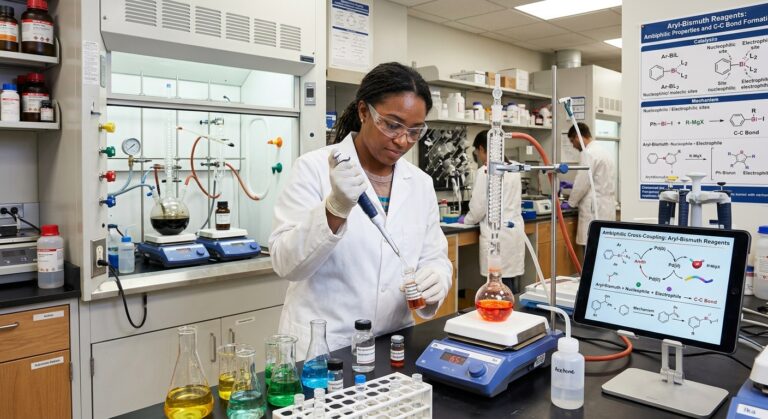
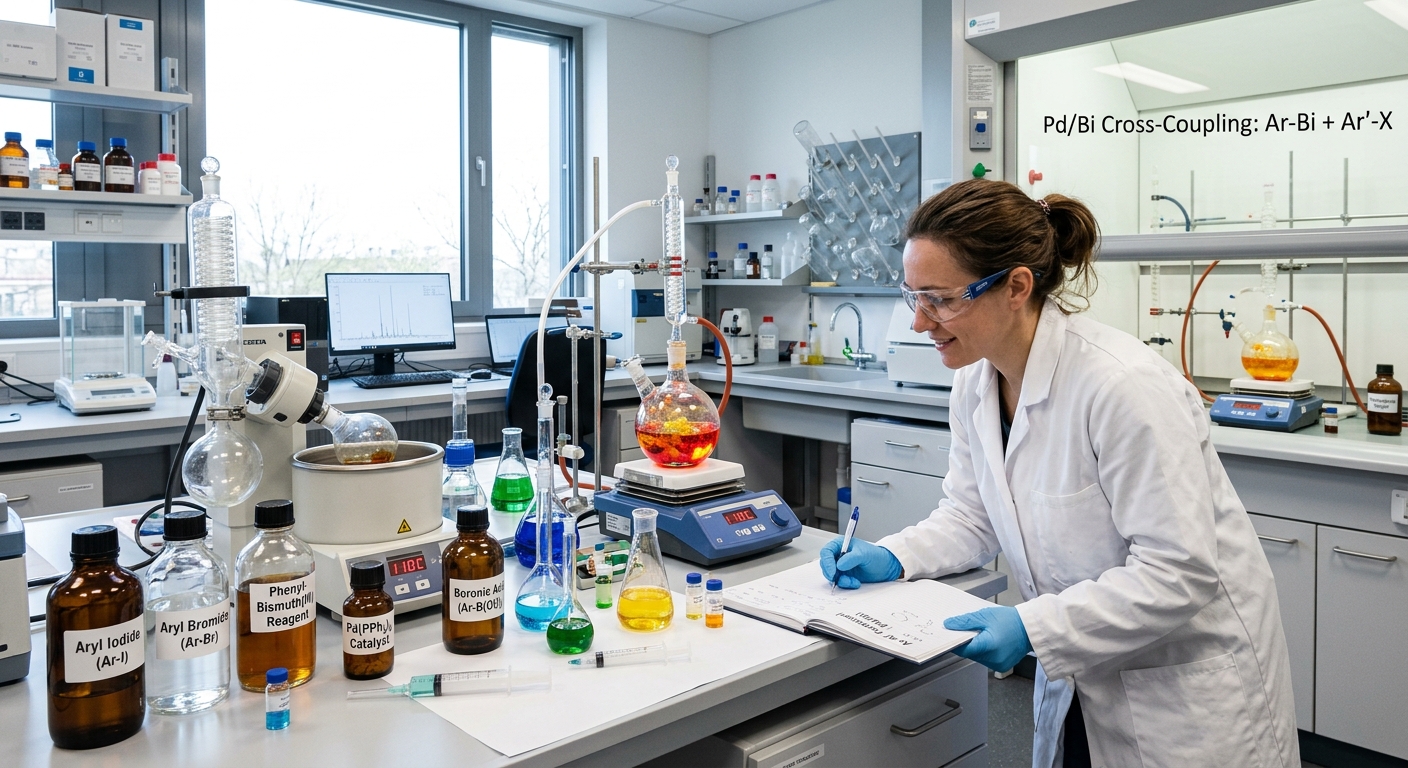
Ambiphilic cross-coupling with aryl-bismuth reagents is revolutionizing transition-metal catalyzed bond formation by allowing these complexes to function as both electrophiles and nucleophiles under palladium catalysis. This dual reactivity enhances synthetic potential, enabling diverse coupling with a variety of partners compared to traditional methods that impose selectivity constraints. The mechanistic insights into oxidative addition and transmetalation processes demonstrate aryl-bismuths’ unique ability to efficiently form carbon-carbon bonds without needing external agents, broadening the applicability for both biaryl structures and late-stage functionalization in drug development.
Ambiphilic Cross-Coupling Overview
This innovative methodology challenges the traditional classification of coupling reagents, positioning aryl-bismuth complexes as uniquely flexible partners in reactions. Their ability to participate in reaction pathways, previously dictated by polarity, allows for compatibility with a variety of substrates, thus offering a broader synthetic scope. Mechanistic studies are confirming that these reagents can effectively engage with different nucleophiles and electrophiles, leading to high-yield coupling products.
Aryl-Bismuth Reagents
Aryl-bismuth reagents are distinct due to their ambiphilic properties, enabling simultaneous actions in cross-coupling reactions without conforming to traditional electrophilic or nucleophilic classifications. Their reactivity allows them to couple efficiently with a broad range of aryl groups, including those with diverse electronic environments. The capability to engage with biologically active compounds further enhances their appeal in modern synthetic chemistry, illustrating their utility in facilitating complex molecuar constructions.
Reaction Mechanism
The unique operation of ambiphilic cross-coupling with aryl-bismuth reagents utilizes their ability to oscillate between roles in oxidative addition and transmetalation. The mechanistic pathway allows these reagents to effectively generate products without external agents, enhancing synthetic efficiency. Employing tailored ligands and bismuth’s redox properties also opens doors to novel pathways in catalysis, underscoring their potential for expanding traditional boundaries in synthetic practices.
Synthesis of Aryl-Bismuth Reagents
The synthesis typically involves creating stable organobismuth(III) complexes, which maintain ambiphilic properties that facilitate their role in cross-coupling. One efficient method includes the functionalization of intermediates to allow for the integration of diverse aryl ligands. This modular approach fosters synthetic flexibility, streamlining complex diversifications without repetitive functional group interconversions.
Catalysts and Reaction Conditions
Ambiphilic aryl-bismuth reagents necessitate innovative catalysts that adapt to their unique reactivity features. The development of bismuth complexes capable of reversible redox cycles plays a significant role in optimizing reactions, often using ligands that enhance catalytic steps while avoiding common issues linked to traditional methods. Mild reaction conditions and carefully designed ligand frameworks allow for the successful engagement of various substrates to maintain flexibility in synthetic applications.
Substrate Scope and Compatibility
The ambiphilic nature of aryl-bismuth reagents facilitates coupling with a wide array of partners, demonstrating significant versatility in substrate compatibility. Their ability to engage with both electron-donating and electron-withdrawing groups allows for rigorous exploration into diverse chemical spaces, including complex drug-like molecules. This method maintains high yields across different electronic environments and functional groups, thereby promising broader applications in synthetic design strategies.
Applications
Ambiphilic aryl-bismuth reagents are reshaping cross-coupling methodologies by offering alternatives to traditional transition-metal catalysts. Their capacity to execute Heck-type couplings via innovative bismuth-centered mechanisms enables efficient reactions under mild conditions, further aligning with principles of sustainable chemistry.
Advantages and Limitations
The versatility of aryl-bismuth reagents as dual functional partners presents considerable advantages over traditional approaches, enhancing both the range of suitable substrates and the efficiency of coupling. However, some limitations still persist, especially in terms of yield consistency for sterically challenging substrates, warranting further optimization of reaction conditions for broader applicability.
Recent Developments and Future Perspectives
Ongoing advancements with ambiphilic aryl-bismuth reagents signal a transformative moment in synthetic chemistry by decoupling reactivity from traditional polarity constraints. Continued exploration of bismuth’s redox capabilities offers compelling prospects for generating more sustainable chemical processes, highlighting the need for further optimization and application of these innovative methodologies in diverse chemical contexts.
The content is provided by Harper Eastwood, Scopewires