
Summary
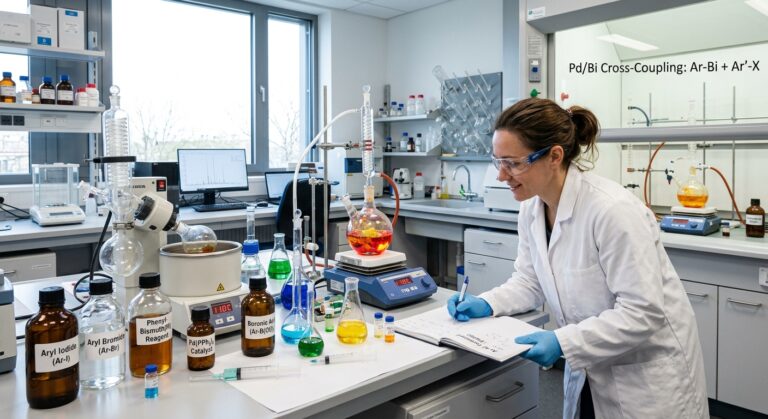
Ambiphilic cross-coupling with aryl-bismuth reagents introduces a new strategy in synthetic organic chemistry, enabling these compounds to act as both nucleophiles and electrophiles. This dual reactivity allows for more versatile cross-coupling reactions, simplifying synthetic pathways, and utilizing inexpensive and non-toxic bismuth sources. The capacity of aryl-bismuth reagents to engage in both oxidative addition and transmetalation highlights their utility in diverse transformations, while their sustainability features reduce waste and energy consumption.
Ambiphilic Cross-Coupling Reactions
In contrast to traditional methods that rigidly categorize reagents into nucleophiles and electrophiles, aryl-bismuth reagents exhibit ambiphilicity, allowing them to operate effectively in both roles depending on specific catalytic conditions. This flexibility simplifies reaction protocols and can enhance yields and functional group tolerance, addressing limitations seen with conventional reagents. Furthermore, eliminating the need for external oxidants or reductants aligns these reactions with sustainable chemistry goals.
Aryl-Bismuth Reagents
Aryl-bismuth compounds, recognized for their stability and high functional group tolerance, can be synthesized through several accessible methods, including transmetalation processes. Their dual reactivity facilitates both oxidative addition and transmetalation in catalytic cycles, making them an attractive alternative for traditional organometallics. Despite advancements, challenges such as substrate scope and the formation of undesired byproducts remain areas for improvement.
Catalysts and Reaction Conditions
Organobismuth(III) catalysts with a bis-aryl sulfone backbone are instrumental in cross-coupling reactions, maintaining redox-neutral behavior during catalytic cycles. Mechanistic studies reveal that these catalysts operate by alternating between oxidative addition and transmetalation processes, which enhances their versatility. Transition metal co-catalysts like palladium and copper facilitate aryl transfer and improve the efficacy of aryl-bismuth reagents, particularly when employing specific conditions such as ultraviolet irradiation.
Substrate Scope and Functional Group Tolerance
The ambiphilic nature of aryl-bismuth reagents enables them to couple a wide variety of electrophiles and nucleophiles effectively, demonstrating a broad substrate scope. Notably, heterocyclic frameworks, often challenging for traditional methods, show remarkable tolerance in these reactions. However, select protic functionalities like primary alcohols remain difficult substrates, indicating areas for continued optimization and refinement.
Recent Developments and Research Trends
Recent findings emphasize the dynamic dual reactivity of aryl-bismuth reagents, transforming the understanding of cross-coupling methodologies. Innovations in bismuth catalysis, coupled with photoredox strategies, present novel pathways that might complement or replace traditional approaches. These advancements not only enhance synthetic versatility but also contribute to greener methodologies by minimizing waste.
Future Perspectives and Outlook
With their ambiphilic properties, aryl-bismuth reagents hold promise for developing novel synthetic approaches that could enhance reactivity and streamline functional group inclusion. Future exploration may focus on the radical and polar reactivity of bismuth, potentially leading to new catalytic systems that utilize bismuth’s unique electronic properties. However, optimizing substrate compatibility and managing side reactions, particularly with protic groups, will be crucial for advancing their practical applications in synthetic chemistry.
The content is provided by Jordan Fields, Scopewires